As governments, local agencies, and citizens in Wisconsin consider investments to improve air quality, the expected health benefits, while presumed, are not forefront or fully articulated. Wisconsin researchers and community members, working as part of the Center for Health, Energy, and Environmental Research, will generate local, quantitative health impacts that would follow from these investments, to provide clear direction and a health focus for choices in the future.
To make sure that the research is relevant to the community and decision-makers, we work together to consider actions that would positively impact energy, land use, transportation, or infrastructure. We select some actions for further evaluation, which will include impacts on air pollution reduction — specifically where, and when.
Examples of actions include the retirement of coal power plants, limiting data centers, increasing trees and parks, or rerouting truck traffic. Researchers at UW–Madison then predict the impacts on local air quality that would result from these changes, while researchers at UW–Milwaukee work closely with Milwaukee Public Schools to estimate the potential benefits to children’s health.
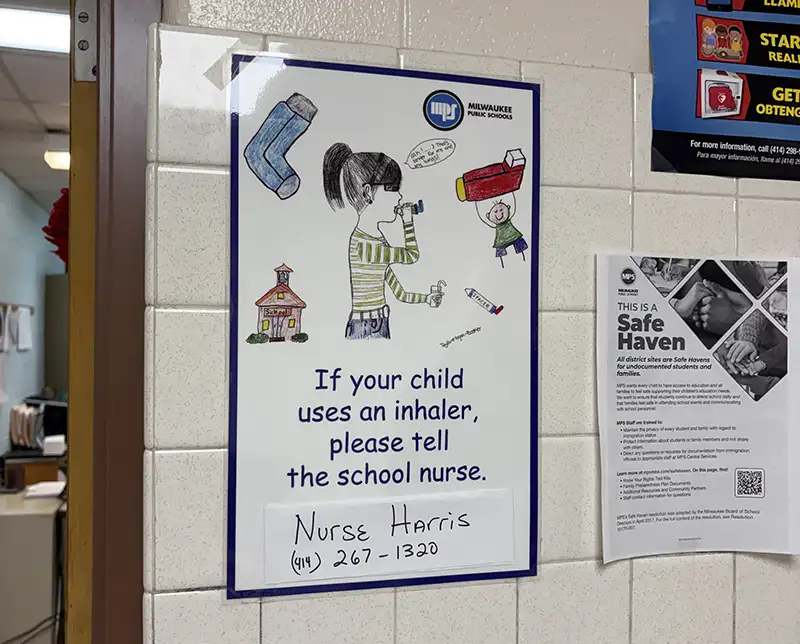
Students in Milwaukee Public Schools are especially vulnerable to health impacts from air pollution. They have a much higher rate of asthma than found nationally and are more likely to be from marginalized groups that often experience higher air pollution burdens. By working with the district, we have defined days when an individual child visited a school nurse because they were wheezing or used an asthma inhaler — concrete signs of needing health care due to asthma symptoms.
We combine this information on school nurse visits with air pollutant levels. We will compare the situation of the actual experienced air pollutant levels with the projected decrease resulting from an investment in infrastructure, energy, or transportation improvements. This will allow us to quantify the potential benefits on children’s health.
These results reflect real-world, local health benefits that pertain to air-pollution–reducing investments and actions that matter to the local community. Knowing this will help to make decisions that not only improve infrastructure and energy choices but improve air quality to best protect the health of children in Milwaukee.
Author Affiliations
- Amy E. Kalkbrenner, professor of environmental health sciences, UW–Milwaukee, kalkbren@uwm.edu
- Kirsten Beyer, professor, Division of Epidemiology & Social Sciences, Institute for Health and Humanity, Medical College of Wisconsin
Both are members of the NIH-sponsored Center for Health, Energy, and Environment Research based at UW–Madison.