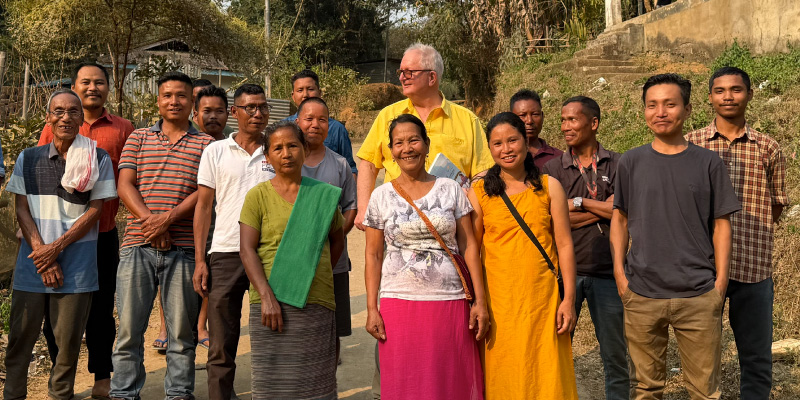
Long before Steven Lawry became an international leader in land rights and environmental governance, his career hinged on a phone call that changed everything.
Fresh out of graduate school in Florida, Lawry was preparing to serve as an urban planner in Venezuela through the Peace Corps when he learned the assignment had been canceled. Instead, he was offered a position in Botswana, a country he had never heard of before. The catch? He had to decide immediately.
“I wanted to work abroad. The job sounded exciting. There was kind of a sense of adventure,” Lawry recalled. “I accepted on the spot.”
That split-second decision set him on a path that would span five decades, multiple continents, and some of the world’s most pressing environmental and developmental challenges. Along the way, he would help shape land reform efforts, influence international policy, and build a career grounded in one enduring belief: environmental solutions only succeed when they account for the knowledge and aspirations of local people.
After four years in Botswana, first as a Peace Corps volunteer and then working on a development project in the Kalahari Desert, Lawry arrived at the University of Wisconsin–Madison in 1980 to pursue a PhD in land resources management. His experience witnessing the unintended consequences of land reform policies in Botswana had sparked questions he wanted answered.
“I needed to learn more about land tenure and land reform,” he said. Those answers led him to the Nelson Institute, where he found the interdisciplinary approach he had been searching for.
“The Nelson doctorate program gave me the framework within which I could take an interdisciplinary approach to these issues of society and environment,” Lawry said.
Rather than studying environmental problems in isolation, Lawry learned to examine the social, political, legal, and ecological systems that shape them. Courses in soil science, botany, law, and the social sciences complemented his dissertation research on pastoralist management systems in the highlands of Lesotho, giving him a broader perspective that became the foundation of his career.
Be alert to unexpected opportunities. They invariably involve having a bit of an appetite for risk.”
— Steven Lawry ’88
Following graduation in 1988, Lawry joined UW–Madison’s Land Tenure Center, eventually becoming director of its Africa programs before moving into leadership positions with the Ford Foundation, the Harvard Kennedy School, Antioch College, the United States Agency for International Development (USAID)’s land rights program in South Sudan, and the Center for International Forestry Research. Across these roles, his work focused on connecting rigorous research with practical policy solutions in land tenure, forest governance, agricultural development, higher education, and philanthropy.
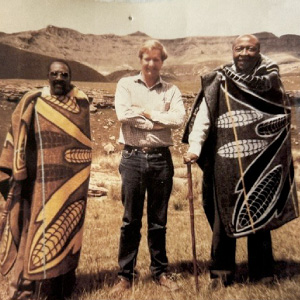
One opportunity often led unexpectedly to the next. While at the Land Tenure Center, Lawry helped organize a training program on land reform for leaders of the African National Congress as South Africa prepared for the end of apartheid. That work introduced him to the Ford Foundation, where he later helped support land reform initiatives during one of the country’s most transformative periods.
Reflecting on his career, Lawry encourages students to remain open to uncertainty. “Be alert to unexpected opportunities,” he said. “They invariably involve having a bit of an appetite for risk.”
Today, Lawry remains closely connected to the Nelson Institute as a member of its Board of Visitors and through the Aldo Leopold Graduate Research Award, a scholarship established by Lawry that supports doctoral students conducting interdisciplinary field research.
The award reflects the philosophy that has guided his life’s work: lasting environmental progress depends on understanding the relationship between people and the landscapes they steward. “People know what they’re doing,” Lawry said. “Land users have an intimate understanding of the health of local environments and are uniquely positioned to ensure their well-being.”
For Lawry, his goal remains as relevant today as it was when he first arrived in Madison from Botswana more than four decades ago. The world’s environmental challenges cannot be solved without understanding the people who live with them every day. It is the same belief that has guided his work across continents, shaped generations of policy and practice, and now stands at the center of his recognition as a Nelson Institute distinguished alumnus.