Children’s Health Alliance of Wisconsin’s Love My Air Wisconsin program, in partnership with researchers from the University of Wisconsin–Madison and Department of Health Services (DHS) toxicologists, are advancing community-centered research to better understand local air quality trends, the connections to everyday activities and broader environmental changes. By leveraging data from low-cost PurpleAir sensors installed at 15 Milwaukee Public Schools, this collaboration is generating actionable insights to support healthier communities.
PurpleAir sensors provide real-time, hyperlocal readings that capture fluctuations in fine particulate matter that is 2.5 micrometers or smaller (PM 2.5). These microscopic particles are a known health concern because they can penetrate deep into the lungs and are associated with asthma exacerbation and other respiratory conditions.
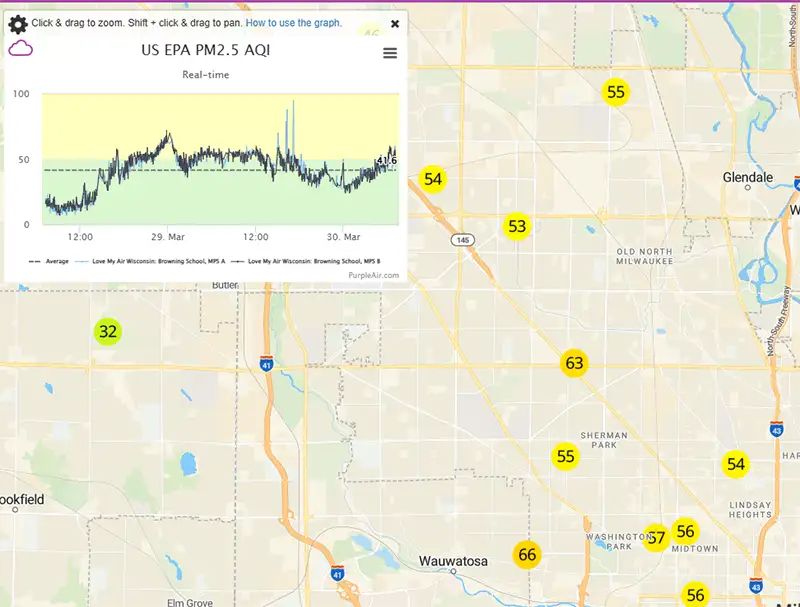
UW researchers and DHS toxicologists are in the process of analyzing millions of data points to identify trends. They aim to answer two research questions:
- Do idling vehicles during student drop-off and pick-up times negatively impact local air quality?
- Is air quality worse during weekdays versus weekends?
If data show there is a correlation, daily routine changes, such as not idling, may improve local air quality. Additionally, data collected during wildfire smoke events show sustained elevated PM 2.5 levels across sensor locations, often lasting for multiple days. Unfortunately, wildfire smoke episodes are becoming more frequent and intense in the Midwest. When combined with localized pollution sources, these conditions can lead to cumulative exposure risks that are higher than either source alone. This compound effect is especially important for sensitive populations, including children.
A key strength of this partnership is its integration of research with community engagement, where the community is driving the research questions. Findings will be shared through DHS communication channels and Love My Air Wisconsin programming to enhance schools, families, local leaders, and public health understanding of air quality trends and ways to take action. Strategies include reducing unnecessary idling, adjusting outdoor activities during poor air quality days, and increasing awareness of access to real-time air quality data.
This collaboration shows how combining community-based monitoring with academic research can reveal both local and regional air quality dynamics. By making air quality data more accessible and meaningful, Love My Air Wisconsin, DHS, and UW–Madison are helping to empower schools and their communities to protect students’ health.
Author Affiliations
- Sarah Mears Kroening, program manager, Children’s Health Alliance of Wisconsin, skroening@childrenswi.org
- Ben Varick, researcher, Nelson Institute for Environmental Studies, Health Oriented Transportation in the Climate Solutions for Health Lab, UW–Madison
- Sam Younkin, researcher, Health Oriented Transportation in the Climate Solutions for Health Lab, UW–Madison
- Kate Beardmore, climate and health program manager, Bureau of Environmental and Occupational Health – Division of Public Health, Wisconsin Department of Health Services
Related Articles