Nora Álvarez-Berríos grew up surrounded by nature in the Puerto Rican mountain town of Aibonito. But it wasn’t amid lush landscapes and vibrant flora that she found her calling for environmental work — but thousands of miles away against icy fjords and vast pine forests of Scandinavia. On a government-sponsored cultural exchange trip, the 16-year-old Álvarez-Berríos was awestruck at the region’s advanced recycling efforts. “I need to do that for my country, for my island,” she thought. Álvarez-Berríos made that her mission, and she’s spent the past 25 years serving Puerto Rico, the Caribbean, and beyond with expertise in natural resource management, applied remote sensing, and interdisciplinary project coordination.
The first step on Álvarez-Berríos’ mission was pursuing an environmental science degree. A first-generation college student, she was accepted to the University of Puerto Rico–Río Piedras as a McNair Scholar. A goal of the McNair program is to support first-generation or other underrepresented students to advanced degrees, so when it came time to apply for graduate programs, UW–Madison’s Nelson Institute for Environmental Studies was one that made the cut. “Ten universities accepted me, but the only one that said, ‘We want you, and we want to fund you,’ was Wisconsin. That was amazing,” she says.
Álvarez-Berríos enrolled in two masters programs, one in land resources with an emphasis on remote sensing through the Nelson Institute and the second in geography with emphasis in people and environment through the College of Letters & Sciences. She found a broad network of support on campus: emotionally through her program’s cohort model, economically with grants covering expenses from research to English writing skills, and academically from professors across the university, including her advisor Lisa Naughton.
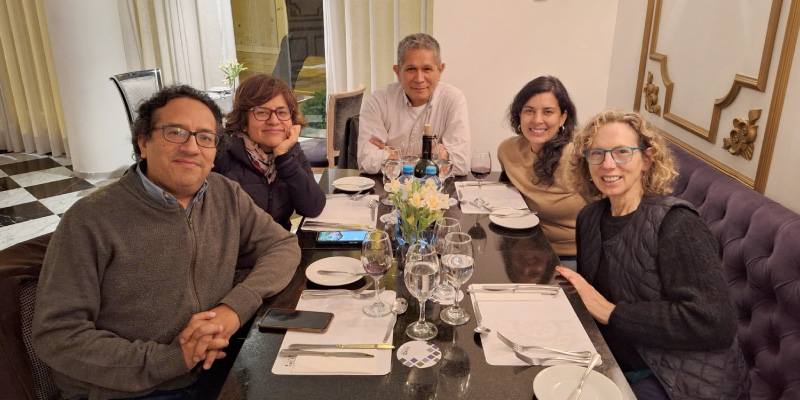
“Lisa was the one who broadened my options,” she says. “What I had designed in my mind was to do work on mangroves in Puerto Rico. But she was the one who said, ‘What if we do some work in the Peruvian Amazon?’ ” This collaboration not only culminated in publication of her thesis, but decades of friendship and shared research. Most recently in 2021, the pair coauthored a groundbreaking study that connected contemporary gold rushes with illegal mining and deforestation.
“I like to listen to people. Because I’m in that intersection of science and policy, I take those stories and I make them visible.”
— Nora Álvarez-Berríos
With two more degrees, Álvarez-Berríos returned to Puerto Rico to fulfill her childhood mission: to bring environmental solutions to her country. She spent several years in research before joining the Puerto Rico Department of Natural Resources for six years. There, she led remote sensing and GIS efforts to support protected areas and manage resources. She also cocreated a public platform for Puerto Ricans to access environmental and historical information.
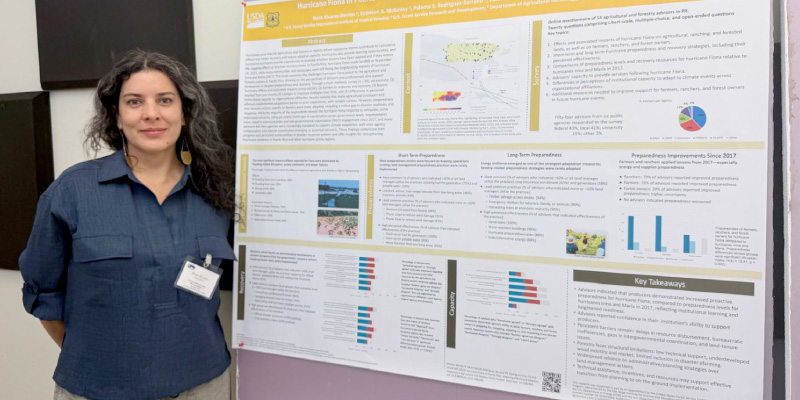
In 2010, Álvarez-Berríos learned about the National Science Foundation Graduate Research Fellowship Program, which provides tuition coverage and annual stipends to students pursuing research-based degrees. She returned to her undergraduate alma mater, and in 2016, graduated with her PhD. She credits her time at the Nelson Institute to helping her jump right into doctoral-level research. “For my PhD, many of my UW–Madison courses were convalidated,” she says. “The classes there prepared me so well that I could concentrate directly on my research.”
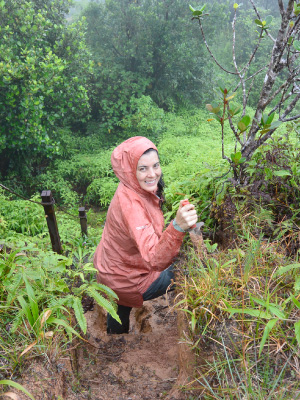
After earning her doctorate, Álvarez-Berríos got back to work serving her island. She joined the International Institute of Tropical Forestry and the Caribbean Climate Hub — which are housed within the Forest Service branch of the U.S. Department of Agriculture (USDA) — and has spent the past 10 years applying her expertise to create on-the-ground, accessible solutions.
To Álvarez-Berríos, a critical piece of her work is elevating the stories of the people on the ground: the farmers, landowners, and citizens. “I like to listen to people. Because I’m in that intersection of science and policy, I take those stories and I make them visible for the USDA,” she says. For example, in July and August, Puerto Rico experienced a widespread and severe drought that led to water rationing and emergency measures. Álvarez-Berríos picked up the phone and called farmers. “What is the situation right now? What are they feeling? Seeing?” she asks. “They’re visible. And that’s something that we always wanted to do. Now with all those reports, the USDA might be able to start an emergency declaration.”
But it’s not a one-way street for Álvarez-Berríos. She’s also spent her career ensuring that science and policy are put back into the hands of the people. In her work at the Department of Natural Resources and at the Caribbean Climate Hub, she helped create public platforms that allow Puerto Ricans to access environmental, climate, and historical information. “I don’t like having databases on my computer,” she says. “I like to publish databases. I like to make the information available and free.”
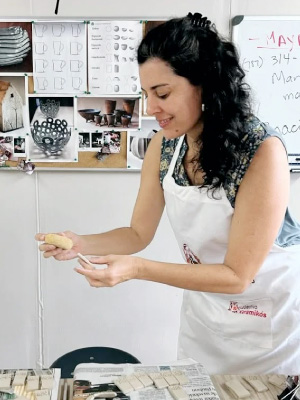
It comes down to this: whether through satellite images or first-person accounts, papers in paywalled journals or publicly accessible databases, Álvarez-Berríos sees beauty in the world and the importance in sharing it. It makes sense, then, that she’s honed another way to express her love of the Earth: ceramics. She discovered it in college, and it has grown from hobby to passion. “I like to connect the environmental part [of my life] with pottery. Most of my pieces have that theme,” she says. She’s currently working on a project that marries her expertise in satellite imagery with ceramics. “I get soil from different parts of Puerto Rico and the Virgin Islands, and I turn them into slips and glazes and see what the colors are,” she says. “I love seeing the earth from above. You see pattern recognition, working with colors and working with texture. My dream is to have [a map of] Puerto Rico, and each pixel is the ground-truth of what the soil looks like when you put it in ceramics.”
For her, art and science aren’t so different. “First, you need to have a question. With a question, you have to listen, you have to see, you have to appreciate, you have to feel it,” she says. “Then you have to be very creative about how you’re going to do your research and finish it. It’s the same with art.”