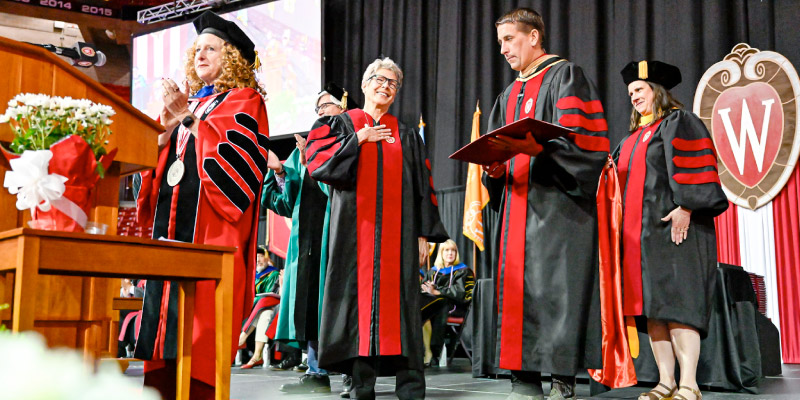
On Friday, May 8, conservation leader and Nelson Institute board member emerita Tia Nelson was recognized with an honorary doctorate at the UW–Madison spring 2026 commencement ceremony.
Nelson — who earned her bachelor’s degree from the UW and whose father was Senator Gaylord Nelson — was recognized for her storied career in conservation. With only one to two given each year, an honorary degree is one of the highest awards given by the university. “Be expansive in your curiosity,” Nelson said in her acceptance speech. “Work with people who see the world differently than you do. Work with persistence.”
Prior to the official ceremony, Nelson met with several dozen graduating students from the Nelson Institute for a special conversation at the Gordon Dining and Event Center. In a discussion moderated by graduating senior Julia Fechner, Nelson reflected on her decades of work in conservation, climate policy, and public service.
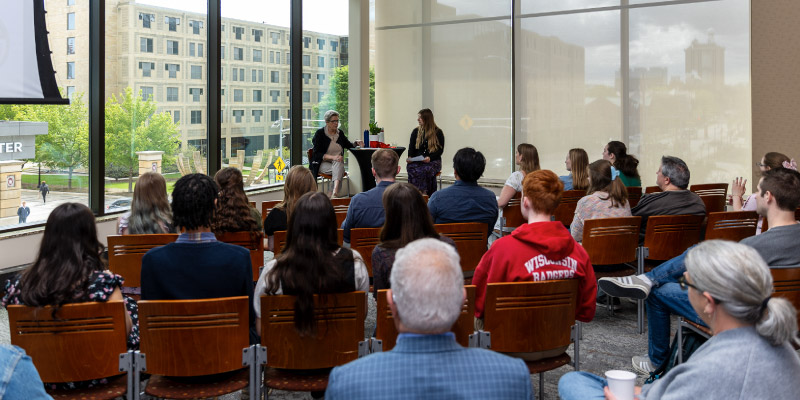
She also got personal about her time as a UW–Madison student, including her experiences in learning with dyslexia. “My struggles academically developed my special power, which was to find the smartest person in the room, to ask questions persistently, and to develop relationships,” Nelson shared.
She also expressed great optimism for the next generation of environmental leaders, noting that, unlike generations before them, they truly understand the urgency and intersectionality required to preserve our world. When asked to share career advice for the Badgers now on the “real world” job market, she said, “There will always be a job [in environmental fields]. Because the challenges and opportunities will always be there.”
See full coverage from the spring commencement celebrations.