ENVIR ST 203
Monday/Wednesday, 9:55–10:45 a.m. + discussion section
3 credits
Instructor

Julie Klinger
Associate Professor of Environmental Studies
jmklinger@wisc.edu
Course Description
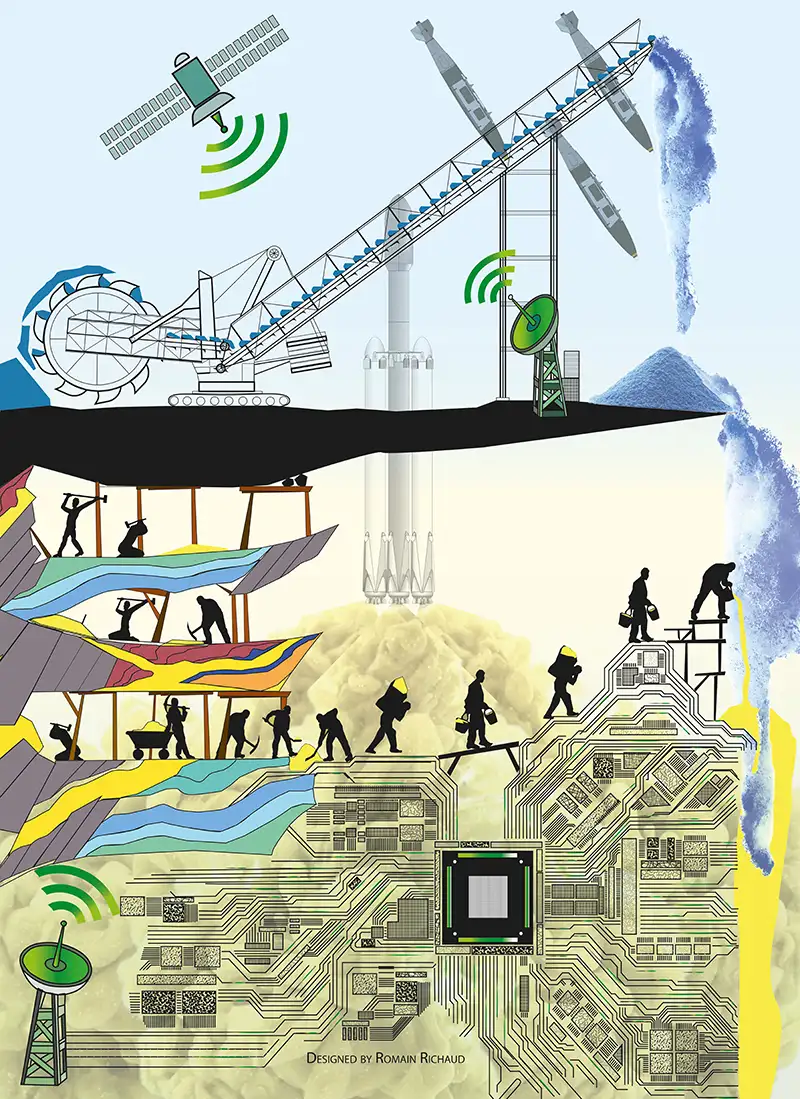
What does your smartphone have in common with a wind turbine, a guided missile, and a Mars rover? They all depend on a handful of elements that most people have never heard of and cannot live without. Cobalt, lithium, rare earths, and dozens of other “critical minerals” now sit at the center of geopolitics, green energy transitions, and fierce debates about whose environments and communities bear the costs of global demand.
This course asks a deceptively simple question: is there enough? Enough minerals to build the technologies we want, enough to sustain the development goals the world has set for itself, and enough to go around if everyone pursues them at once?
The honest answer is that while there are strong opinions and lots of predictions, nobody truly knows. But the ways we try to answer it reveal a great deal about what kinds of futures we want to build, for whose benefit, and at what costs.
No prior background in geology, economics, or environmental studies is required. We begin from the ground up literally, with the formation of the Earth, and trace how certain rocks came to be classified as “critical,” which ideas shaped those lists, and what happens in the places where they are mined.
From there we examine sustainable development and its critics, the resource curse debate, the laws and politics governing who owns minerals on Earth, beneath the deep seabed, and in outer space, and exciting new approaches that look beyond extraction altogether, including recycling and recovering metals already circulating above ground.
Along the way, the course draws on multimedia materials, case studies, and guest speakers to connect big questions to lived experiences. Assessments emphasize cultivating greater intellectual sophistication with the facts and debates surrounding critical minerals: overcoming the many challenges we will learn about in this course requires multidisciplinary approaches, perspectives, and understandings.
Students will leave able to explain where critical minerals come from, why they matter, what we can do about the challenges that surround them, and how to communicate that knowledge to many different audiences.
UW Designations

Elementary
