The Nelson Institute Issue Brief summarizes the latest scholarship from the University of Wisconsin–Madison, highlighting faculty and graduate student work on key environmental issues. The Issue Brief is not a peer-reviewed publication.
Introduction
As conversations around alternative energy continue, much of the focus is expanding beyond carbon reduction to consider a broader array of societal benefits and challenges. Recent technological advancements and policy proposals have drawn attention to a wide range of energy projects across the U.S. and throughout Wisconsin.
Yet, questions remain about scalability, long-term costs, and the complex trade-offs involved in balancing energy needs with environmental and social priorities. Most challenging is ensuring projects are both supported by local stakeholders and appropriate for the social, economic, and environmental context affected by its development.
Successful projects promise not only reduced greenhouse gas emissions, but also the opportunity to diversify the energy grid, increase climate resilience, and create economic opportunities for rural and urban communities alike.
In Wisconsin, energy needs intersect with agricultural and industrial economies, and there is significant potential that alternative energy can offer these sectors. Wind energy continues to expand in the state while project developers strive to balance visual and ecological impacts of turbines.
Rooftop solar installations are growing rapidly in urban and suburban areas, decentralizing energy generation and reducing grid reliance. Meanwhile, agrivoltaics — dual-use systems that combine solar energy production with agricultural activities — could offer a transformative approach for Wisconsin’s farming communities.
The renewed interest in nuclear power as a stable, carbon-free energy source further highlights the urgency of exploring a diverse portfolio of energy approaches. As Wisconsin strives toward its 2050 goal of carbon-free electricity, the integration of these technologies offers
a pathway to a cleaner, more resilient energy future; however, the transition will require careful consideration of public concerns, ecological trade-offs, and differential access to the benefits promised by alternative energy.
This edition of the Nelson Issue Brief is the second of a two-part series on renewable and alternative energy and continues the conversation by highlighting recent research from UW–Madison scholars on nuclear energy in clean energy transitions, renewable natural gas and its economic feasibility, agrivoltaics to combine solar energy generation and agriculture, and the potential for rooftop solar expansion on UW–Madison’s campus.
Key Points
Small nuclear reactors can provide cost-effective, on-demand, low-carbon energy to complement renewables in locations with limited or inconsistent wind and solar.
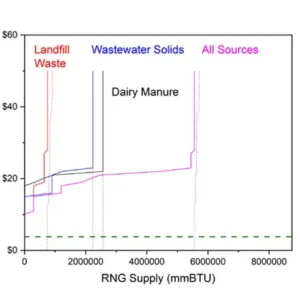
There are significant financial and technical limitations to consider in renewable natural gas (RNG) development, including its heavy reliance on renewable fuel credit programs for profitability.
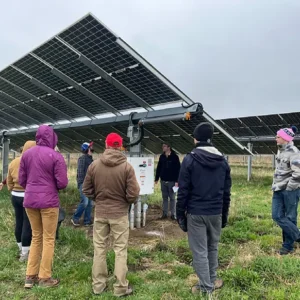
Agrivoltaics integrates solar energy generation and agriculture on the same piece of land, increasing efficiency and sustainability through dual land-use solutions.
Rooftop solar could meet 15-24 percent of the UW–Madison campus’s electricity needs and would offer learning opportunities while advanc-ing sustainability goals.
Stories

Advancing Sustainability by Exploring Rooftop Solar Potential at UW–Madison
Adding solar to on-campus facilities contributes to our institutional mission by offering a visible learning and research opportunity while demonstrating a commitment to sustainability.
BadgerVoltaics: Agrivoltaics at UW–Madison’s Kegonsa Research Campus Solar and Agriculture Pilot Project
The pilot project will be a living and learning laboratory to further conversations about win-win opportunities to pair renewable energy and agricultural and ecosystem services research.
Renewable Natural Gas: A Case Study of Minnesota
Under ideal production conditions, the potential to make RNG from municipal solid waste, dairy and hog farm manure, and municipal wastewater solids in the state could replace less than 10 percent of Minnesota’s current use of conventional natural gas.
Roles for Nuclear Energy in Clean Energy Transitions
While there are clear opportunities for the expansion of wind and solar energy in many U.S. electricity markets, and especially in Wisconsin, there is growing evidence that deep decarbonization of our energy system will need to rely on a low-carbon electricity source that is available on demand.