


Forget four walls and a whiteboard. This classroom comes with a lake view.
For students in the Nelson Institute’s environmental conservation master’s program, biodiversity comes to life in the field. In Conservation of Biodiversity, one of the program’s first courses, students explore Madison’s lakes, streams, and green spaces while gaining hands-on experience with the ecosystems around them.
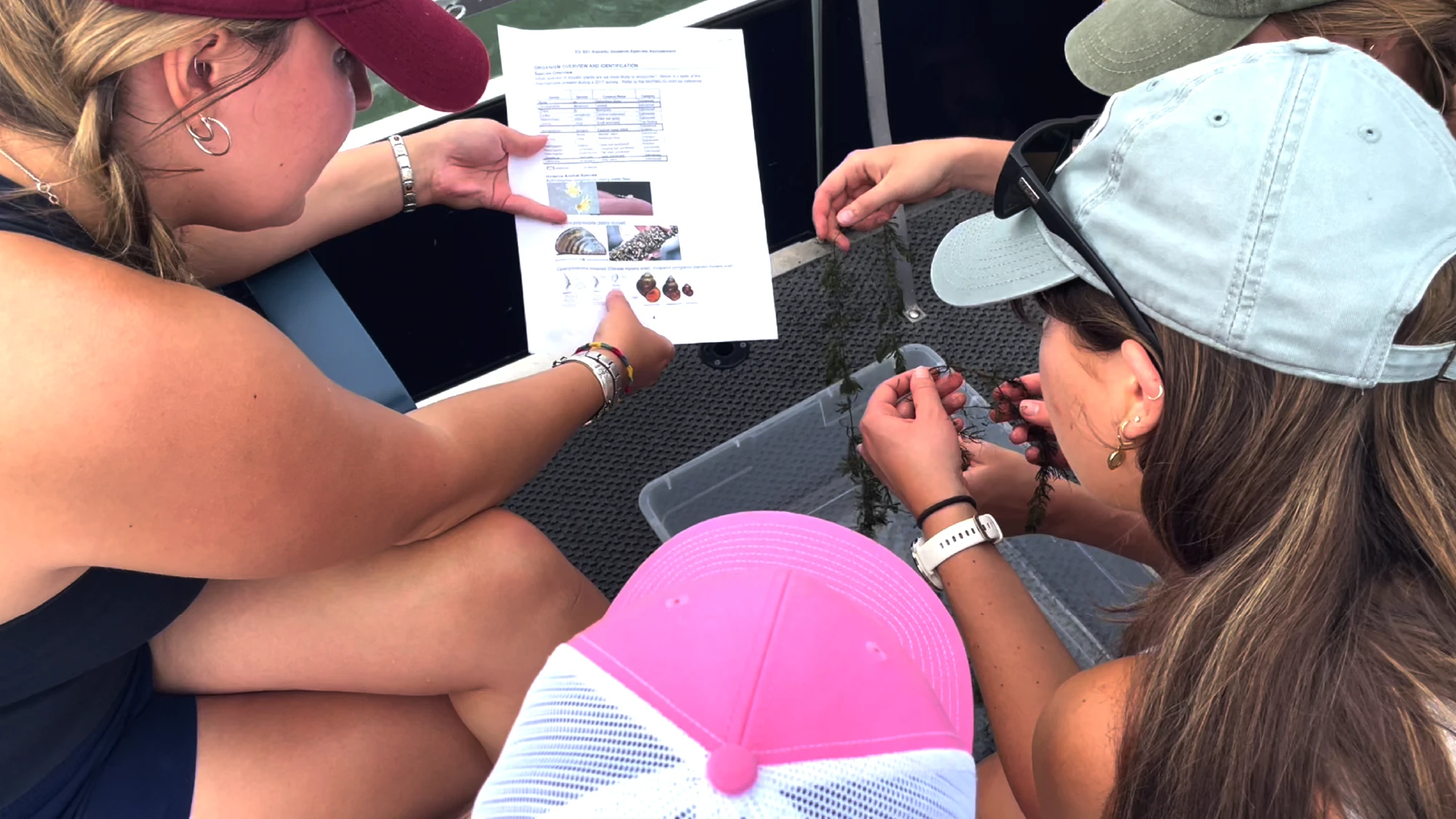
On Lake Monona, students used aquatic rakes to discover what’s living beneath the surface, collecting and identifying native and invasive plants while examining the impacts of nutrient runoff and algal blooms. The fieldwork gives students a chance to dig into real-world conservation challenges while exploring their new home, getting to know their classmates, and building connections within their cohort.
Follow along to discover what lies beneath the surface of Lake Monona — and what these students pull up.
Transcript
Transcript may be edited for clarity or brevity.
Cooper (instructor): I’m Cooper Rosin. I’m a member of the teaching faculty at the Nelson Institute and the course I teach is Conservation of Biodiversity which is a core natural science course for the environmental conservation professional masters program.
Taught each summer, Conservation of Biodiversity is one of the first courses students take in the environmental conservation master’s program, launching them into an immersive season of hands-on learning.
Meeting twice a week over two months, the class takes students beyond the classroom and into the field to set camera traps in the UW Arboretum, study aquatic invertebrates in local streams, and collect native and invasive species from Lake Monona.
Cooper: Today, we’re on Lake Monona and we’re doing an aquatic invasive species assessment. So, we use aquatic rakes to pull up aquatic macrophytes — vegetation — and students got a chance to see which species are native, which species are invasive, and, more broadly, we talked about the ecological and environmental consequences of these being urban lakes where we have invasive species. We have nutrient run off issues. We have algal blooms. So, students are getting kind of a holistic perspective on the environmental challenges of our lakes.
With the help of volunteers and pontoons provided by Madison School & Community Recreation, the class collected samples from Lake Monona near Olbrich Beach and Schluter Beach, identifying, analyzing, and cataloging the native and invasive species they found.
Ellie (student): So, we’ve been out here on the lake sampling for aquatic plants, specifically looking at what invasives and natives are getting pulled up. One of the groups of plants that we’ve been pulling up is milfoils and there’s a native species and an invasive species. You can tell the difference by counting the number of leaflet pairs and we actually also found a hybrid of one of these on the lake which is pretty cool.
Kiana (student): We were also looking for some invertebrates as well like the zebra mussel and the quagga mussel.
Ellie: We’re pretty concerned with eutrophication because of all the nutrients that run off into the lake and that can cause algae blooms that then disrupt the water quality and also the food web and then that further can diminish the water quality and that has a huge economic impact on the lake and what activities we can do there. So, the homeowners, us, and all of the people around Lake Monona and Mendota are pretty invested in understanding how we can preserve the water quality.
Cooper: So, these are urban lakes and we have all kinds of urban lake issues. A lot of them have to do with excess nutrients and whenever we get excess nutrients in our lakes, we feed all that algae. Another thing students were focused on today was understanding the effects of invasive species and these cause all kinds of issues. Again, students are trying to gain an understanding of these big environmental challenges but we talk through in our field exercise and in our class, what sorts of solutions are out there and that’s a lot of what these students care about most is finding solutions to big problems like this.
The Nelson Institute’s environmental conservation (EC) program is a 15-month master of science degree that prepares students to address today’s most pressing environmental challenges.
Through a blend of ecological science, social science, and professional training, students develop the knowledge and skills to make informed decisions, collaborate effectively with diverse communities and stakeholders, and lead efforts that create meaningful environmental impact.
Sophie (student): Yeah, it’s been going really good so far. I like the cohort system. Like, we spend a ton of time together and that’s kind of nice especially coming from far away so I don’t know people in the area other than these people. I also like that the program focuses some on professional skills too because I feel like those are really valuable.
Ellie: Yeah, I’d say that I’ve also really been enjoying the cohort system. It’s been so great to get to know all of the people really closely and develop those relationships. And the Nelson Institute staff have also been really really focused and involved with our program so it’s great to get to know them and feel really supported and they’re really concerned with helping us become the best versions of ourselves. So, that’s really been wonderful as well
Cooper: I love teaching this class because we have highly motivated students that are engaged and want to pursue careers in conservation. They want to do meaningful work. So, they come here prepared to learn and what we try and teach them through the program is not only the essential scientific knowledge, but also applications of that knowledge and conservation skills. So, one of my favorite parts about this class in particular is that we get a few opportunities to get out in the field and do field exercises beautiful day like this out on the lake where we’re learning real skills but students are having fun and so having a class in the summer where we have students who are new to Madison and they can be introduced to a beautiful season before winter hits that’s probably my favorite part of this class.

