

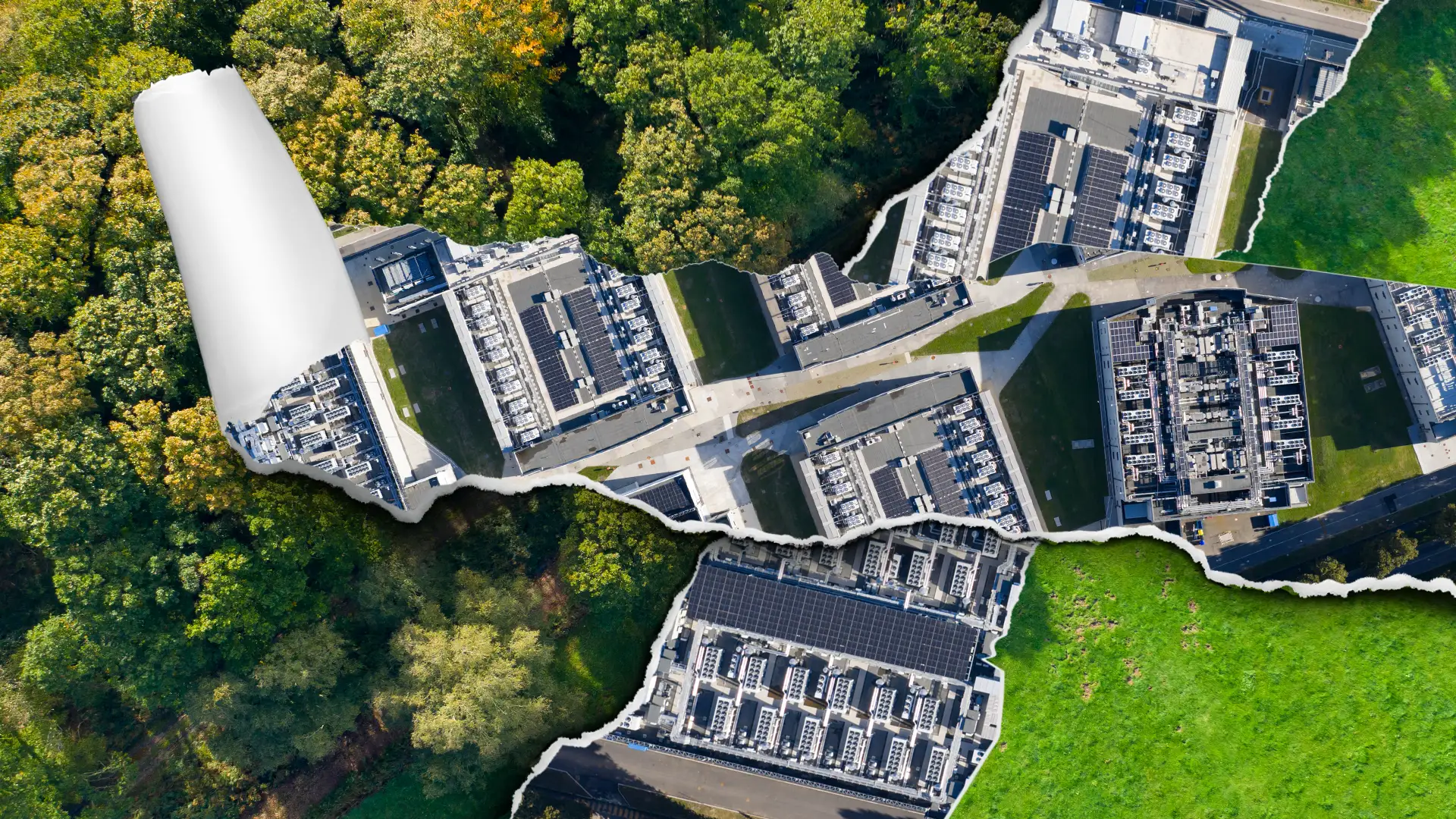

“I’m researching the environmental impacts and opportunities of data centers in the U.S.,” I type into ChatGPT. “Please compile three concerns, three innovations, and a list of active research related to data centers and the environment.”
Send.
The words are translated and beamed to a massive data center, location unknown. The model reads it, builds a response, retranslates it, and shoots it back.
In 16 seconds.
“Nice — good, timely beat,” Chat responds, followed by an organized list of 30 links. My research time shrank from hours to seconds — a win for productivity. But … Chat’s detailed response may have required up to a bottle of water to cool the processing equipment. But … by working more efficiently, my computer used less energy.
For every pro, there’s a con. The environmental impacts of AI — specifically the data centers used to power it — is a growing topic of conversation between community members, policymakers, and tech companies. How can we support the need for AI data centers while also maintaining sustainable, resilient communities and landscapes? It’s tough to set policy and parameters without data-driven, peer-reviewed evidence. It’s harder yet to publish relevant research with such rapidly changing technology.
Like you, experts at the University of Wisconsin–Madison have questions — lots of them. What don’t we know about how AI and data centers will impact our planet? Can we create a framework for a net-positive, data-driven world? As data centers break ground and technology advances daily, researchers are on a race against the clock. Go inside the minds of five interdisciplinary scholars as they share their most pressing questions.
The Connector: Land and Resource Integration
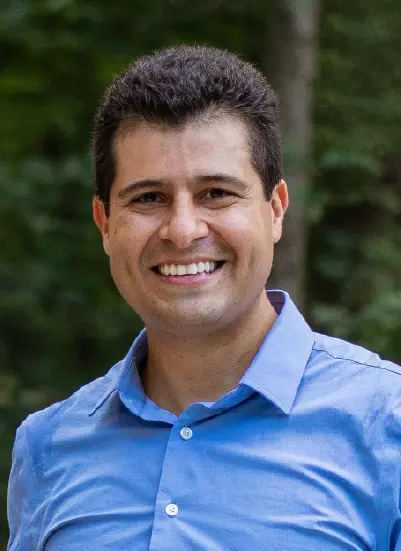
Horacio Aguirre-Villegas
Scientist III
Expertise: Life cycle assessment, waste management, agricultural sustainability
All data centers start with the same need: land. Smaller centers are infiltrating urban areas, taking up warehouses, empty buildings, and even old malls. But AI-supporting large-scale campuses need flat, cheap acreage by the thousands. “Usually, that’s prime agricultural area,” says Horacio Aguirre-Villegas, a Nelson Institute researcher. With a background in agriculture and systems-thinking, Aguirre-Villegas wonders, “How do you integrate this?”
It’s well documented that these mega data centers use a lot of energy. On the other hand, dairy farms with digesters — systems that turn manure into energy — often produce more energy than the farm can use, Aguirre-Villegas notes. What if a data center was built next to that farm and purchased its excess energy, at a premium, to partially power the campus? In return, what overflow resources do data centers have that could support neighboring farmers? One example, says Aguirre-Villegas, is heat. “They need to cool all these servers, and all that heat is being wasted, right into the atmosphere,” he explains. If the farm next-door could capture that, it could theoretically heat greenhouses through winter — or help power the digester, which then feeds energy right back to the center, creating a circular system. Plus, fewer emissions would be released into the atmosphere.
Aguirre-Villegas, alongside Becky Larson, professor of environmental studies at the Nelson Institute, is taking steps to see if these ideas could work. “Like with everything else, there’s a need for resources to dedicate to these types of analysis,” he says. “[Tech companies] have the money … they could have an impact in communities around them.”
The Activist: Infrastructure and Community Consent
Gabriel Shapiro
Environment and Resources PhD Student
Expertise: Energy justice, transmission lines
But what if communities simply aren’t interested in hosting AI data centers? Gabriel Shapiro, a PhD student in the Nelson Institute and the Department of Geography, is researching intersections of community resistance and energy infrastructure. He’s specifically interested in resistance to the transmission lines required to power AI data centers.

In tracking community resistance to data center projects, Shapiro is noticing a pattern: decisions are happening without community input or approval. In Port Washington, Wisconsin, residents have vocally opposed a $15 billion, 2,000-acre data center campus. The common council approved it anyway, and it’s currently [status]. “The problem is not that comments weren’t gathered — thousands were. It’s that they had no effect on the outcome,” Shapiro wrote in an op-ed for The Cap Times. For Shapiro, this raises a larger question about democracy, accountability, and transparency.
He sees this lack of transparency in transmission line proposals, too. In October, American Transmission Co. applied for a $1.4 billion transmission line that would span 90 miles and five counties. The need? “To serve a new large load addition in the Port Washington area,” the application says. (The Port Washington data center is expected to use 1.3 gigawatts of energy. That’s enough to power over 1 million Wisconsin homes, reports Clean Wisconsin.)
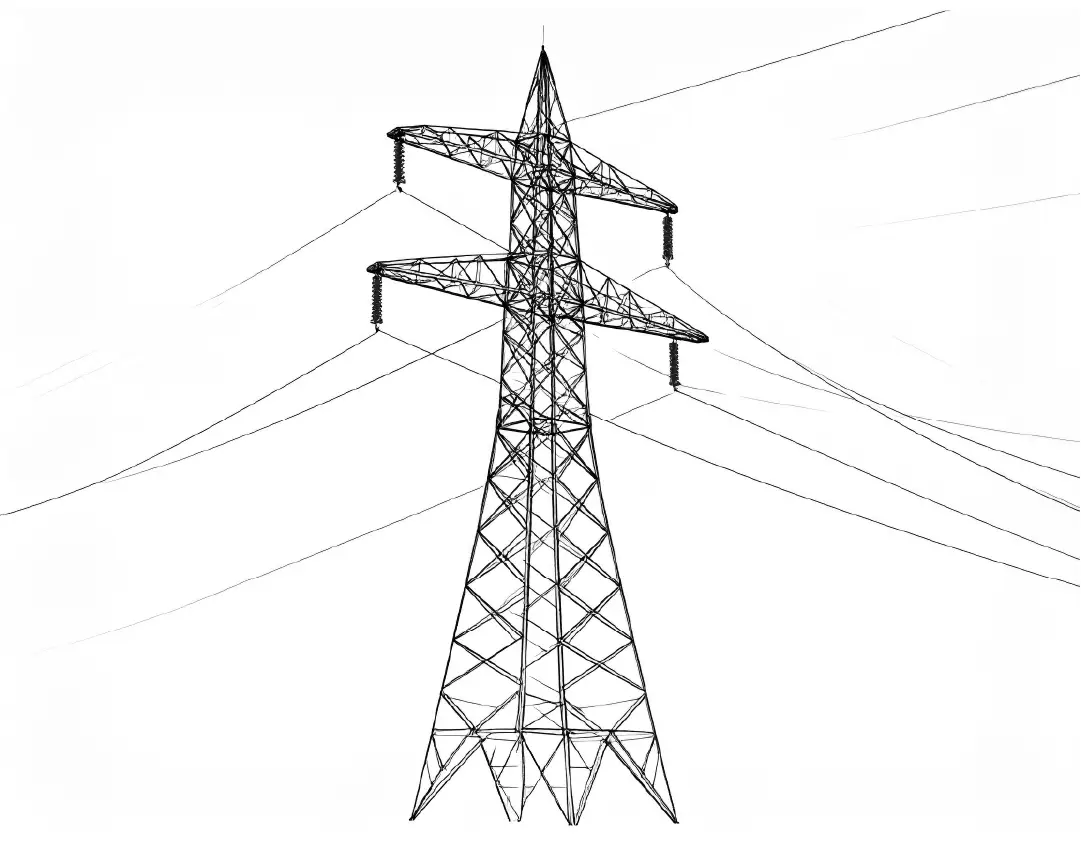
People in communities along the proposed line, including along its planned backup route, have been uniting to speak out against the project. They’re creating websites, forming coalitions, and contacting local news outlets. “Communities don’t get to choose. We don’t get a catalog of industrial projects,” Shapiro says. “They get this power line, and it gets stuffed down their throat.” Not to mention, he adds, “we don’t know exactly how the costs are going to be distributed for the transmission line.”
This story isn’t necessarily new. A wealthy, global company approaches a small, rural town, promising jobs and economic growth. “I think data centers are the next thing in a long line of things that small-town mayors have looked to as ways to stimulate the tax base, build the local economy, and bring jobs in,” he says. But a data center? “People are just not seeing it as worth it.”
The Cautious Optimist: Biodiversity Cobenefits

James Crall
Assistant Professor, Entomology
Expertise: Pollinators, agroecology
If AI data centers are poised to reshape our landscapes and energy bills, what benefits could they offer us? For James Crall, a research affiliate in the Nelson Institute’s Center for Ecology and the Environment and an assistant professor in the College of Agricultural and Life Sciences, the potential for AI to monitor and support biodiversity is “enormous.”
Have you ever learned about a bird on the Merlin app, or identified a wildflower on iNaturalist? That’s AI, and it takes data processing. Every species logged in a “citizen science” app is a win for biodiversity, argues Crall. “It’s one of the best resources for biodiversity monitoring.”
Hyperscale data center campuses may also have the potential to boost biodiversity monitoring, Crall says. By partnering with a data center before it’s built, scientists could get a rare “before and after” look at how a campus changes insect biodiversity. This could also have positive impacts on neighboring communities. “Can we monitor not only a native habitat on the campus it’s impact on pollinators,” he asks, “but also understand how those biodiversity impacts (like pollination) ‘spill over’ into adjacent landscapes?” Crall has more than a decade of experience using automated monitoring systems to address these kinds of questions.
He’s also curious about the investment in large-scale solar to power data center campuses. Could those arrays become sites for studying how insects and pollinators respond to “high-use, heavily managed landscapes?” His lab has already developed a framework for this, using the UW’s Kegonsa Research Campus and its agrivoltaics array. If agricultural and native landscapes are converted into solar fields to power more data centers, “can we make those not only have the climate mitigating impacts through getting renewable energy, but also directly benefit biodiversity by providing habitat and microclimate refugia?”
Picturing a nationwide data center landscape, Crall asks, “Could these all be centers of standardized, long-term biodiversity monitoring? That’d be a real boon to the field of insect biodiversity to even just understand population status and trends.”
The Protector: Justice and Sovereignty
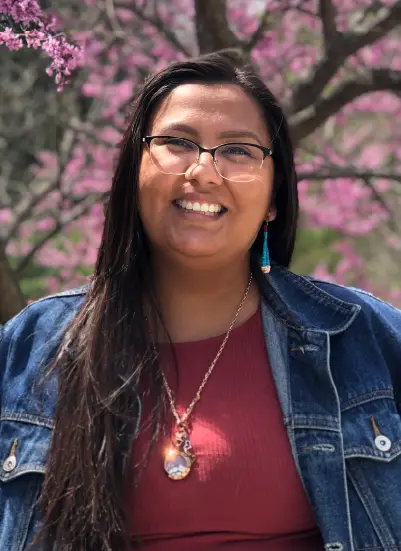
Jennifer Jones
Environment and Resources PhD Candidate
Expertise: Energy justice, Indigenous rights
If AI-powered apps and integrated hyperscale data center campuses could reshape biodiversity monitoring globally, what are the downsides? Jennifer Jones, a PhD candidate in the Nelson Institute, is exploring the intersection of AI data centers and Tribal lands. Can something extractive by nature — not just in collecting data, but using mass quantities of natural resources — ever pair with communities whose values are centered around stewarding and protecting the land?
Jones, who is Diné/Navajo, is focusing her dissertation on energy justice — specifically AI-driven data centers and Tribal communities. While community-integrated, sustainable, and net-positive data centers are intriguing, she’s curious about the larger implications of building data centers on Tribal lands. At the MTERA (Midwest Tribal Energy Resources Association) Summit in October, Jones listened to developers pitching data centers — small and large — as the next big thing for economic development within Tribal communities: “your next casino opportunity,” they said. “If a business is coming to this community and saying, ‘Hey, we’ll give you billions of dollars to build this infrastructure and lease the land for us,’ there’s a big red flag for me,” Jones says. “Our communities thrive on working for each other, working with the land. And this perspective of ownership of land, once again, goes in conflict with that.”
In the United States, private industry has a long history of seeking Tribal lands for building infrastructure projects like pipelines and coal plants. “Tribal lands have been sought after for energy generation, like coal and uranium mining. Yet, like many underrepresented communities, they are among the last to be connected to electricity,” she says. Jones references the Navajo Generating Station in her community, which operated from 1974 through 2019. After struggling to keep up with environmental regulations, utility providers voted to close the plant — which had provided 700-plus jobs and millions in revenue to the Navajo Nation.
When the plant shut down, there were still 25 years left on the operator’s initial agreement to the tribes. Not only was the community left with a revenue loss, they also had thousands of acres of land to remediate on their own. Jones fears a parallel with AI-driven data centers. What happens to the community if the company ceases operations? What happens to the land when the technology advances and hyperscale campuses aren’t needed anymore?
“In the process of energy development, there have been interactions with Tribes that have minimized our sovereign decision-making and rights,” Jones says. “If there have not been improvements in equitable regulatory practices, I worry that the same process of extractive power plants will continue with AI data center developers’ desire to site projects on or near Tribal lands.”
The Negotiator: Power and Accountability
Julia Towne
Environmental Conservation MS Student
Expertise: Community conservation, tech industry
For Julia Towne, an environmental conservation master’s student in the Nelson Institute, the starting point is clear: AI data centers should strengthen communities, not undermine them. And from her experience, communities hold a lot more bargaining power than they think.

Towne spent three decades inside Google and Microsoft with a front-row seat to the negotiation dynamics that communities are facing with data center developers. Today, she uses that expertise to help communities protect their land, budgets, and long-term resilience as the data center boom accelerates.
Let’s start with who holds the cards. “If a company has chosen your land, your power grid, your water, and your location, that means the community already holds the strongest cards,” Towne says. “Instead of defaulting to tax breaks or concessions, local leaders should insist on binding protections — community-benefit agreements, impact fees, and enforceable environmental standards that create real, measurable value for residents.”
Beyond helping communities strike deals to mitigate effects, Towne also stresses the need for communities to plan for the full life cycle of a data center. The first computer took up 1,800 square feet. Today, you’re probably wearing one on your wrist or carrying one in your pocket. What happens when the tech improves and data centers don’t need 1,000-acre campuses? Will communities be left with empty buildings and unusable land?

“A data center’s life cycle is short, but its environmental footprint can last decades,” Towne cautions. “Abandonment or recovery bonds are essential — they ensure the company, not the community, pays for decommissioning and land restoration when technology moves on. Sustainable development means ensuring innovation doesn’t leave communities exposed.”
For Towne, the goal is not just economic growth, but basic fairness. She wants to see communities guide development, not absorb its consequences. “If communities use the leverage they already have to negotiate real protections, data center development doesn’t have to come at their expense,” she says.
Now What?
While the questions are myriad and indisputably complex, progress and innovations aren’t too far off. “AI is the kind of monster that we all dread: heavy-fisted, lightning fast, and wildly unpredictable,” says Paul Robbins, dean of the Nelson Institute. “But it’s a monster we turn on and set into motion every morning when we boot up our computers. UW–Madison is the best place to get our heads around this kind of creature.”
There are opportunities to develop policy frameworks to ensure equitable regulatory practices and Tribal sovereignty, Jones theorizes. “There is potential for data centers to be good grid citizens,” offers Shapiro, if they are built in a way that doesn’t require transmission upgrades or puts new costs on communities. The key is planning for these problems before we’re stuck mitigating the consequences, which will serve all sectors in the long run. “When governance and innovation move together, sustainability becomes more than a goal,” says Towne, “it becomes practice.”
But to meet the challenges in time, researchers will need resources. “Private industry is so important because they have resources to invest,” says Aguirre-Villegas. Or as Crall puts it, “If we get real engagement from all of the companies fueling the rise of these data centers, there’s an enormous potential to do a lot of fascinating research really fast.” Few examples exist of pairing environmental research with data center planning. Columbia University’s Data Science Institute launched a partnership with IBM in 2024 to start digging into sustainable solutions. Siemens recently sponsored a one-year project with LeHigh University to investigate micro-grids. And most recently, QTS Data Centers invested $1.5 million in UW–Madison’s Nelson Institute to lead research on the sustainable development of data centers.
“Scholars here understand land and water systems, circular economics, political economy, and big data. Most important, around here, our community commitments come first. I’d like to see the UW as the center for exploring, explaining, and guiding the direction of data center development,” Robbins adds. “There are too many questions still unanswered; I trust this campus community, before anyone else, to get objective, grounded, tractable answers.”

