


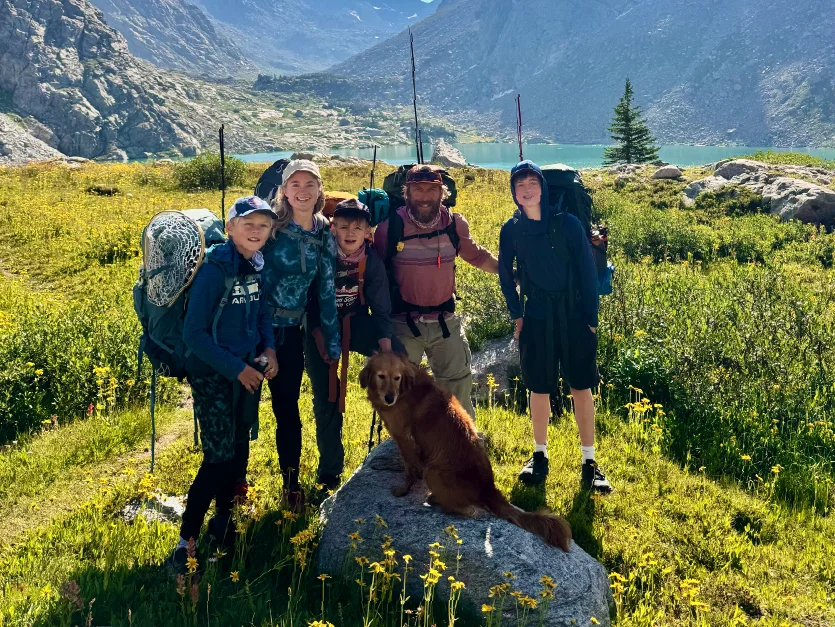
For five days and six nights this summer, Holly Gibbs PhD’08 went off the grid. She’s one of the world’s most highly cited researchers, but during her annual backpacking trip with her husband, and their three school-age sons, she was an adventurer, a naturalist, a mother. This year, they hiked 50 miles through Wyoming’s Wind River Range.
She may trek the American wilderness, but Gibbs is a leading scholar on the Brazilian Amazon. She’s a professor and researcher in the Nelson Institute for Environmental Studies, where she also earned her PhD. But her academic path started quite differently.

As a kid, Gibbs was set on becoming a veterinarian. She shadowed at clinics, had her own cat adoption center, and attended The Ohio State University on an undergraduate pre-vet track. But all that changed in a natural resources class, where she learned how clearing tropical forests to grow food can ultimately reduce rainfall and productivity across entire regions. She was struck by the unintended consequences of deforestation for food production and the sustainability of entire rainforest basins. “I realized that environmental problems weren’t isolated — they were connected to the way people use land and produce food,” she remembers. “I knew that I wanted to understand the bigger systems behind these problems and help both people and forests.”
Make change became a guiding principle of Gibbs’ career. She continued at Ohio State after undergrad, earning her master’s in environmental science and then worked as a remote sensing researcher at Oak Ridge National Laboratory. While exploring doctoral programs, she sought an experience that would pair rigorous research with on-the-ground impact. She found it at the Nelson Institute working with Jon Foley ’90, PhD’93, the institute’s inaugural Gaylord Nelson Distinguished Chair in Integrated Environmental Studies — a position which Gibbs now holds.
For her PhD, she explored the interaction between tropical deforestation, climate change, and food systems at the global scale. She fine-tuned her expertise in GIS and spatial analysis, while learning to integrate human behavior and social systems into environmental models. “The environment and resources graduate program gave me the opportunity to focus deeply on a specific environmental problem while developing the interdisciplinary research skills and methodologies to address it,” Gibbs says. Just as importantly, she developed communication and engagement skills that allowed her to connect scientific research with policy across disciplines and perspectives.
But these weren’t just theories learned in classrooms; they were skills applied with international decision makers. Throughout her studies, Gibbs traveled the world. During United Nations Framework Convention on Climate Change climate negotiations, for example, she got a firsthand look at the challenges of developing international policies to reduce emissions from tropical deforestation. After listening and learning from environmental practitioners and policymakers from different countries and perspectives, she started to adapt her research to address the needs directly emerging from those discussions. She realized that her dissertation could do more than advance scientific understanding — it could help inform decisions about how to address deforestation and climate change. I saw my dissertation science directly inform and influence decisions at the global scale,” she says. “I was hooked.”
After earning her PhD, Gibbs went to Stanford University to conduct postdoctoral research on global implications of U.S.-based biofuels policy, specifically how it affected deforestation in Brazil. Then, in 2010, she gave birth to her first son, and her whole world changed. “Having a child inspired me to redouble my efforts to tackle critical environmental problems and work even harder to ensure my science translated into action on the ground.”
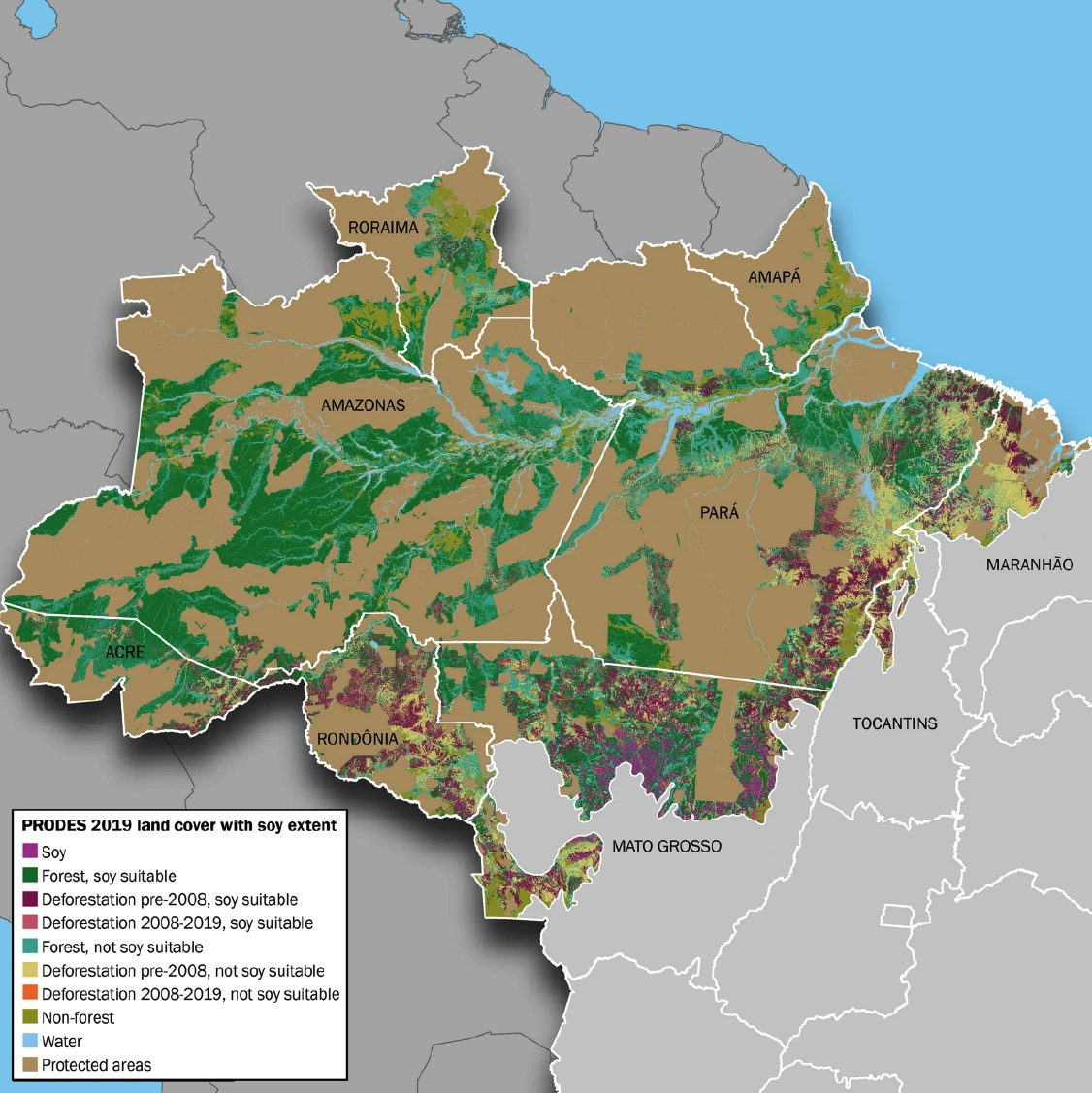
Around that same time, she learned about Brazil’s Amazon Soy Moratorium, in which companies agreed to stop purchasing soy produced on deforested lands. For Gibbs, the moratorium revealed a new possibility: companies themselves could become agents of change. “Instead of relying solely on the international community or on the Brazilian government, we saw companies like Cargill, a Minnesota-based soy trading company, come in and make commitments to stop deforestation for soy in Brazil.” She couldn’t get it out of her mind. “I decided to take a leap and shift what I was researching.”
With this new direction for her research, Gibbs returned to the Nelson Institute as a faculty member. “My goal has always been to lead the most rigorous science I can and use it to address important real-world problems. For me, impact and academic excellence aren’t competing goals,” Gibbs says. “Nelson created a space where I could take risks to pursue the questions I’m most excited about and strengthen and refine my scholarship through engagement and partnerships beyond academia.”
The risks paid off and led to remarkable academic success. In 15 years on the faculty, Gibbs has secured nearly $20 million in direct research funding for her lab and published in top journals including Science, Nature, and PNAS. She has been recognized with multiple teaching and career awards and, in 2026, was inducted into the American Academy of Arts and Sciences. She has also been ranked among the top 1 percent of highly cited researchers for three years in a row.
To Gibbs, it’s the public-facing, interdisciplinary nature of her research that lets her dig deeper. “Engaging with policymakers and companies helps us ask better scientific questions,” Gibbs says. “It allows us to identify the problems that matter most and then bring cutting-edge methods to answering them.”
Through this approach, Gibbs became deeply involved in both the science and policy surrounding the Amazon Soy Moratorium. In 2016, the Brazilian government was poised to end the moratorium after a decade of annual renewals. But Gibbs and her team at her Global Land Use and Environment (GLUE) Lab had just published a paper showing the critical role of the moratorium in reducing deforestation linked to soy production during its first 10 years. As government officials and companies prepared to end the policy, Gibbs presented her findings to those involved in the moratorium. “Following my presentation, they reversed their decision and continued the moratorium indefinitely,” she says. “That was a key moment of seeing what rigorous, credible science can mean for policy and decision-making processes.”
Twenty years after the moratorium was first established, the scientific and political debate was reignited. Around the same time, Gibbs’ team published “The rise and fall of the Amazon Soy Moratorium” — led by Lisa Rausch, GLUE lab member and scientist in the Nelson Institute’s Center for Sustainability and the Global Environment. The paper, which examined the moratorium’s continued importance amid political changes across Brazil, was cited during Supreme Court proceedings as Brazil debated whether to uphold the moratorium in August 2026. The court ultimately upheld the constitutionality of the moratorium — but also allowed states to restrict tax benefits and other public incentives for companies participating in such agreements. It was a devastating blow to the moratorium, which has now been largely abandoned by major soy traders.
That certainly doesn’t mean the work stops; far from it. Gibbs and her team continue to leverage their science to help stakeholders develop alternatives to the moratorium that both keep Brazil’s agricultural sector on the international market and reduce pressure on the Amazon. Recent research in the GLUE lab shows that soy crop expansion in the Amazon leads to increased pesticide usage, which in turn has been associated with childhood cancer deaths. These findings are raising new questions about the public health consequences of continued soy expansion, particularly as production moves northward into Indigenous territories where contamination of local water sources could pose heightened risks to community health.
Gibbs is also applying her research to the Brazilian cattle sector, the largest driver of deforestation in the Amazon. For the past two years, Gibbs and her team have focused on making these cattle systems visible by developing a foundation AI model that maps individual animals across the Amazon, including on deforestation frontiers and in areas of illegal encroachment into indigenous territories. “We’ve shifted from tracing paperwork to measuring reality,” she says. “When cattle are no longer invisible, the rules of the game change, and we can find long-lasting solutions for ranchers and the forests”. Her work on soy and cattle has attracted support from major philanthropic organizations including the Bezos Earth Fund and the Gordon and Betty Moore Foundation.
After decades of studying land-use change around the world, Gibbs is now turning her attention closer to home. It’s here that she finds hope in individual-led conservation efforts — from private properties in rural areas to rewilded lawns in our suburbs and cities. Working with a team of graduate and undergraduate research scholars, she is exploring how privately owned land can serve as an important avenue for conservation — helping protect pollinators, improve water quality, and enhance home values, all at the same time. “After spending 20 years looking across the world, and across these rainforest nations … I want to come home and consider what we’re doing here, and what we could do differently,” she says. “I think that this is a space that can bring hope to all of us.”


