


Can irrigation infrastructure help farmers adapt to a changing climate? A new study co-authored by Joel Ferguson, assistant professor at the Nelson Institute for Environmental Studies, suggests the answer is yes. By analyzing more than 3,000 satellite images spanning 30 years, the researchers found that irrigation projects in Senegal’s River Valley produced long-lasting increases in cultivated farmland while making crops more resilient to temperature extremes.
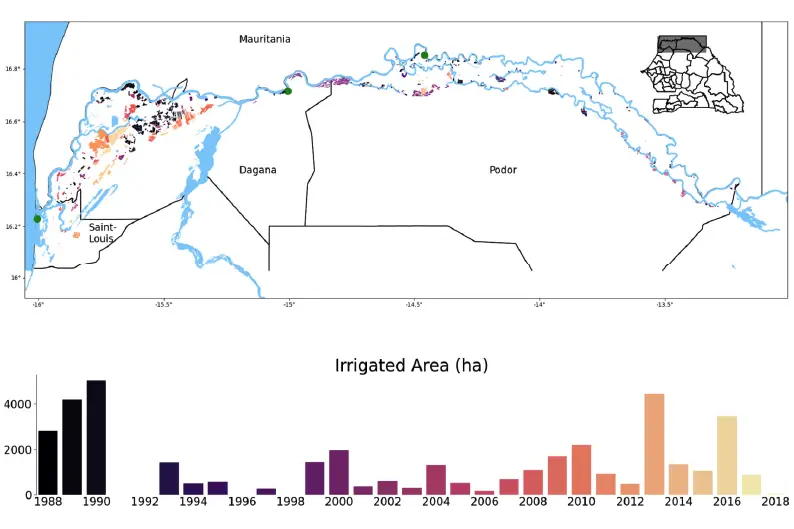

The study also highlights irrigation’s critical role in helping farmers adapt to climate change. Crops grown on irrigated land were significantly less affected by both unusually high and unusually low temperatures, demonstrating that reliable water access can reduce agriculture’s vulnerability to climate extremes.
While the overall findings show substantial and lasting gains from irrigation investments, the researchers also found that success varied considerably across projects. Farmer surveys revealed that many producers still face persistent barriers to accessing water, leading to intermittent cultivation even where irrigation infrastructure exists. The findings suggest that building irrigation systems alone is not enough, and that continued investment in water access and management is essential to help farmers fully realize the long-term benefits of irrigation.

