

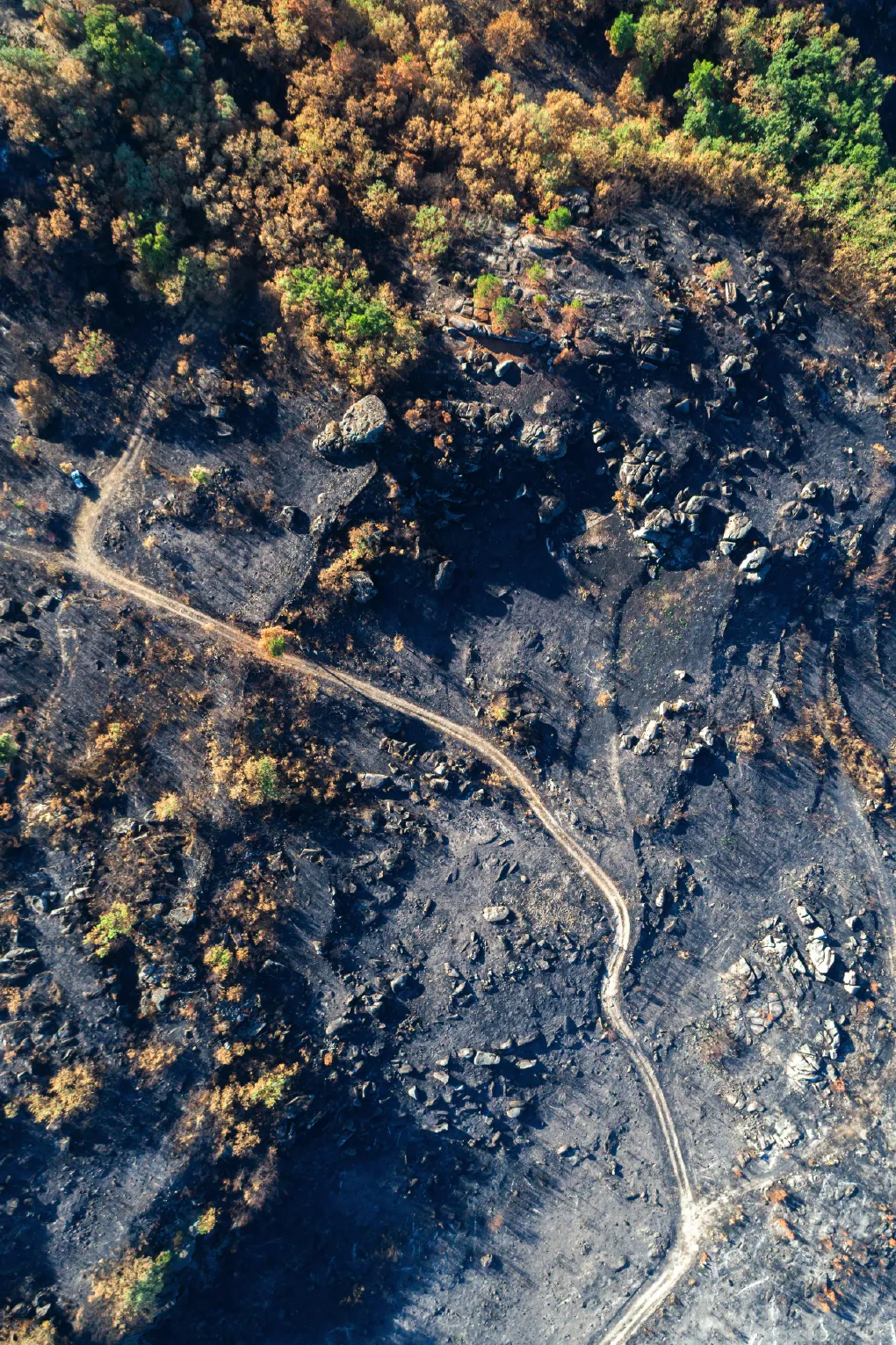

Wildfires are becoming more frequent and severe across many regions of the world, reshaping ecosystems and influencing the global climate in complex ways. A new research project led by Min Chen, assistant professor within the Nelson Institute’s Center for Climatic Research (CCR) and the College of Agricultural and Life Sciences, aims to improve scientists’ understanding of how wildfires affect interactions between land, water, energy, and the atmosphere — and how those changes are represented in climate models.
The project, Understand and Reduce Uncertainty in E3SM’s Land-Atmosphere Feedbacks on Carbon, Water, and Energy in Response to Wildfire Disturbance, will work to improve the U.S. Department of Energy’s Exascale Energy Earth System Model (E3SM), an advanced tool used to simulate climate and ecosystem processes.
Current Earth System Models often struggle to accurately capture wildfire behavior and the long-term effects fires have on terrestrial ecosystems and atmospheric systems. To address these gaps, Chen and his team will develop new benchmarking metrics for land-atmosphere feedbacks and integrate them into the International Land Model Benchmarking framework. The project will also apply machine learning and surrogate modeling techniques to improve wildfire simulations and reduce uncertainty in predictions of post-fire ecosystem resilience.
By advancing wildfire and climate modeling, the research will support more effective climate mitigation and adaptation strategies in a warming world.

