

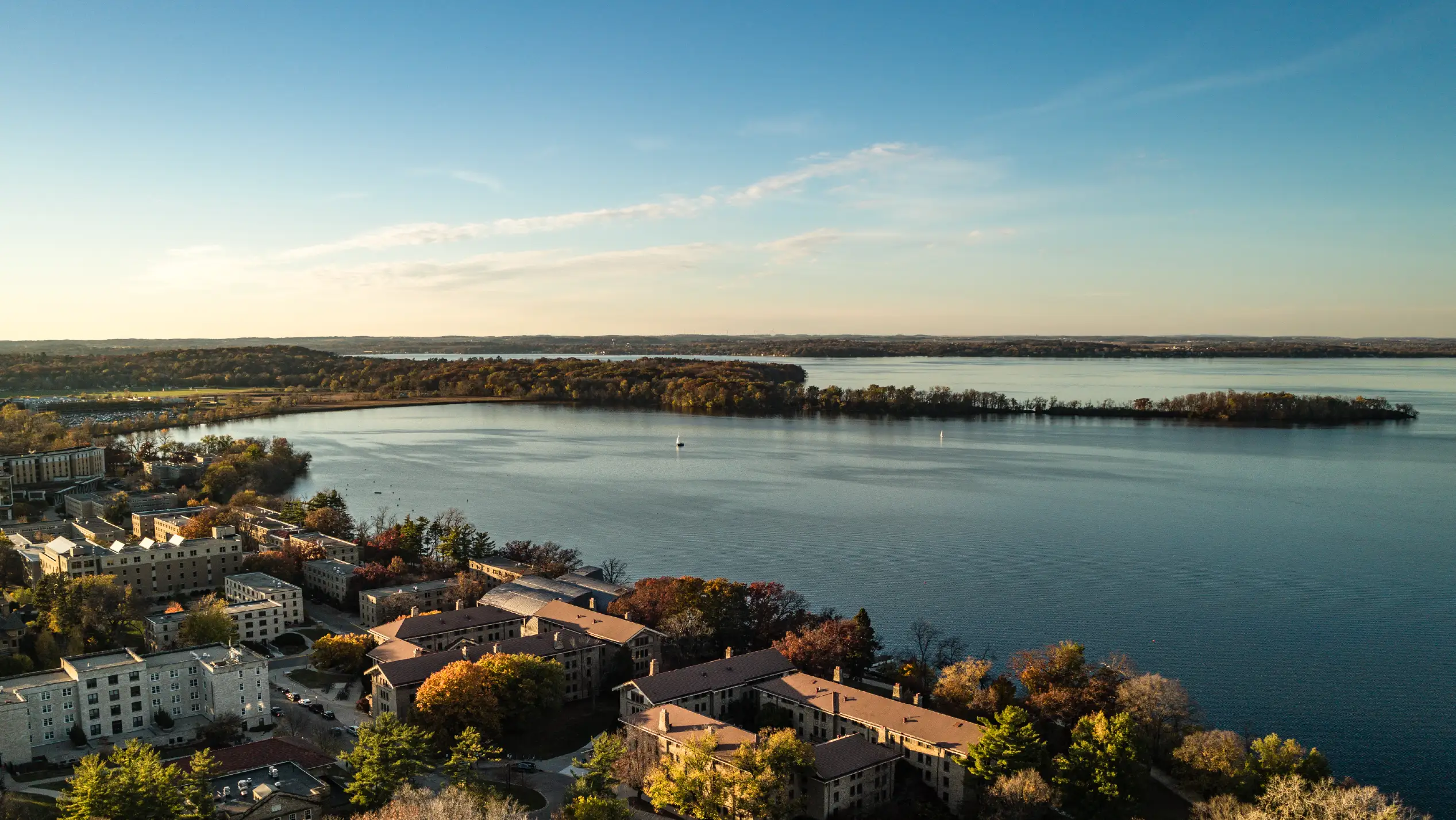

Few places are as synonymous with UW–Madison as the Lakeshore Nature Preserve. Whether it’s watching the sunset from Picnic Point, studying beneath the trees between classes, or gathering around a fire circle with friends, generations of students, alumni, and visitors have made memories along the shores of Lake Mendota. Woven into daily campus life, the preserve is more than a scenic backdrop — it’s a place for teaching, research, recreation, and reflection that helps define the Wisconsin Experience.
“It’s educational, it’s recreational, and it’s a place for respite and wellbeing,” said Bryn Scriver ’97, MS’05 volunteer and outreach coordinator for the Lakeshore Nature Preserve. “I can’t imagine UW–Madison without the Lakeshore Nature Preserve.”
“It’s very unique,” said Brad Herrick, director of the Lakeshore Nature Preserve and PhD candidate in the Nelson Institute’s environment and resources program. “Especially because it’s nearly a third of the size of campus.”
But even for those who have wandered its trails, there’s much more to discover. Beyond Picnic Point lies 300 acres of restored landscapes, with a history stretching back 12,000 years. From serving as one of the university’s largest outdoor classrooms to engaging hundreds of volunteers each year, here are five things you may not know about UW–Madison’s iconic Lakeshore Nature Preserve.

1. The preserve is much more than just Picnic Point

For many at UW–Madison, the Lakeshore Nature Preserve begins and ends with Picnic Point. The trail’s sweeping lake views have made it one of the university’s most beloved destinations, but the Preserve extends far beyond its scenic peninsula. Stretching from Eagle Heights apartments to the Hasler Laboratory of Limnology, it includes woodlands, restored prairies, marshes, and more than four miles of Lake Mendota shoreline — the longest publicly owned stretch of shoreline on the lake.
“Muir Woods is on one end, and Wally Bauman Woods is on the other end,” Herrick said. “And there’s great trails that connect all of those. So, there’s a lot to explore.”

2. People have lived there for 12,000 years
The Lakeshore Nature Preserve’s story begins long before the University of Wisconsin–Madison — or even the state of Wisconsin — existed. People have lived along the shores of Lake Mendota for roughly 12,000 years, leaving behind a rich cultural history that includes more than 40 documented archaeological sites. Today, the Preserve is the site of Indigenous effigy and burial mounds, as well as habitation sites, serving as an important reminder that this landscape has been home to generations of people for thousands of years. “We know how important it is to steward and protect those resources,” said Scriver.

3. It almost became lakeside neighborhoods instead of a nature preserve
In the 1830s, surveyors documented the landscape that would eventually become the Lakeshore Nature Preserve as a mosaic of prairie, wetlands, and oak savanna. Over the following decades, much of the land was farmed, grazed, and developed with homes before parcels were gradually acquired by UW–Madison. The final addition, Frautschi Point, was donated to the university in the 1990s.
The Preserve nearly had a very different future. Historic maps show plans to subdivide Picnic Point into lakeside home lots, while what is now Biocore Prairie was once envisioned as the site of a large estate complete with a horse arena. Those developments never came to fruition, leaving behind the 300-acre natural area that thousands of students, researchers, and visitors enjoy today.
“We’re so lucky to have these lands as a public resource,” Scriver said. “If they hadn’t been acquired by the university, [they] wouldn’t be available for us all to enjoy”


4. It’s really an outdoor classroom — not just a park

Out there, class bells are bird chirps and toad croaks. While many visitors come to the Lakeshore Nature Preserve to hike, birdwatch, or unwind, its primary purpose is advancing UW–Madison’s teaching, research, and outreach mission. In 2025 alone, the Preserve supported 60 teaching and research permits across 25 courses representing 16 academic departments, with additional projects led by external organizations.
“The Lakeshore Nature Preserve is, first and foremost, an outdoor classroom — or a living learning laboratory,” Herrick said.

5. It Takes Hundreds of Volunteers to Keep the Preserve Thriving

More than 180,000 people passed through the entrance to Picnic Point last year alone. Yet despite welcoming thousands of visitors each week, the Lakeshore Nature Preserve continues to feel like an escape into nature.
“Hopefully it doesn’t look like that many people are using the Lakeshore Nature Preserve,” Scriver said with a laugh. Keeping it that way takes year-round work. More than 700 volunteers contribute thousands of hours each year alongside university employees and student interns, helping stock firewood, maintain trails, remove invasive species, and restore native habitats so the Preserve can continue serving the campus community for generations to come.

