


Sound on!

For a more immersive experience, we recommend reading this story while listening to this audio captured by the Sound Forest Lab. Grab your headphones and hit the play button.
Pretend, for a moment, you’re standing in the center of the Baraboo Hills, a pocket of undisturbed upland forest less than 50 miles from the Wisconsin State Capitol. Close your eyes. What do you hear? How many unique animals and insects can you identify — cawing above the canopy, rustling behind in the brush? Now imagine each species as its own track in a complex audio file. And delete three-quarters of them. What does it sound like now?
Zuzana Buřivalová is an associate professor in the College of Agricultural and Life Sciences’ Department of Forest and Wildlife Ecology, a faculty affiliate in the Nelson Institute for Environmental Studies, and a researcher in its Center for Sustainability and the Global Environment.
If global conservation stays on the same trendline it has for the past 50 years, that’s exactly what will happen. Since 1970, the world has lost nearly 75 percent of wildlife populations. That’s what Zuzana Buřivalová, a researcher at the University of Wisconsin–Madison, is on a mission to reverse using one of the most visceral, cross-cultural experiences: sound. She’s focused on forests, which house more than half of Earth’s animal species and cover about 30 percent of the planet. She’s spent the past five years pairing global community connections with cutting edge artificial intelligence to create the Soundscape Baselines Projects, which redefines how we understand biodiversity — and evaluate our efforts to save it.
Good, But Not Good Enough
At UW–Madison, Buřivalová leads the Sound Forest Lab. Broadly, her goal is to identify the effectiveness of conservation methods, as well as document biodiversity loss from human activities. But through this work, she found a problem. How do we know if an intervention is “working” if we don’t have a reference point? What metrics aren’t we getting from measurements like satellite imagery? “You can have forests that look kind of intact from satellite imagery, but animals might be gone,” Buřivalová explains. Say, for example, a reforestation project promises to plant 10,000 trees. What percentage of the original bird species might return to those trees? “We have grown so used to quantifying results of conservation by just counting the number of green hectares — which is good, but it’s not good enough.” That’s where sound comes in.
Buřivalová first learned of bioacoustic monitoring — using recorded audio for species identification and analysis — during postdoctoral work with The Nature Conservancy. She’d been conducting fieldwork in tropical forests, but her efforts were limited by how much ground she alone could physically cover. But the idea of remote monitoring through recording equipment? “I was instantly, completely sold because you could be at multiple places at the same time,” she says.
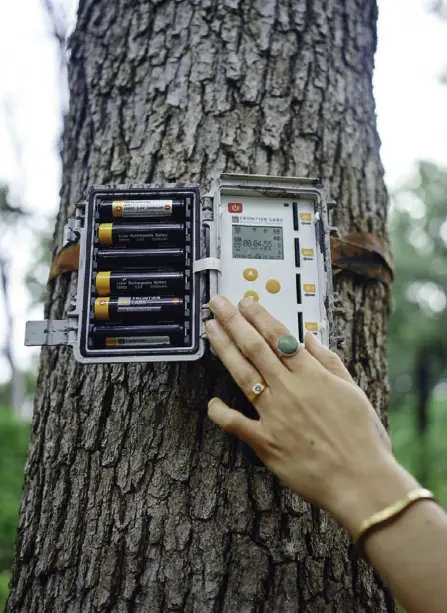
The technology itself is rather unassuming. In fact, thanks to its tree-bark camo design, you might miss it entirely. The autonomous recording units are small — similar in size and shape to a basic trail camera. With slots for batteries, memory cards, and an omnidirectional microphone, they capture a fully immersive soundscape, 24/7, from anywhere in the world. All you need to do is mount it to a tree and hit “record.”
With coverage limitations removed, Buřivalová began to think beyond her first field sites in Papua New Guinea and Indonesia. Could soundscapes document forests of the world? There are 844 ecoregions across the planet; only 181 have intact forest landscapes left: “Forests that have not been industrially converted or logged in recent history,” she explains, “are disappearing super fast.”
Although progress has been made against deforestation, Buřivalová notes, she sees a missed connection with conserving the biodiversity within them. “We have forests, but we are increasingly modifying them,” she says. “My goal with the Soundscape Baselines Project is to bring biodiversity back to the decision-making table and make sure that we have forests that are full of biodiversity and not just empty forests.”
Wisconsin Connections
With far-flung partner stations recording a variety of forest types, Buřivalová needed a close-to-home forest both for recording and equipment troubleshooting. She found the perfect site in the Baraboo Hills of Wisconsin’s Columbia and Sauk Counties, just north of the UW campus. The six Baraboo Hills recording units are positioned in places such as Hemlock Draw, a valley owned by The Nature Conservancy on the western edge of the natural area.
“The forest–savanna transition zone of the Upper Midwest in Wisconsin is a mosaic of oak-dominated woodlands, open savannas, and early successional habitats shaped by fire, climate, and land use history, with pockets of old forests. At dusk, the soundscapes typically have the calls of frogs, chorus of birds settling for the night, and sometimes coyotes,” reads the baseline’s description.
Watch as Buřivalová and her team check equipment at the Baraboo Hills site in this episode of “Great Lakes Now,” a program by PBS Detroit.
Empowering Partners
To get the project off the ground, Buřivalová activated a network of community and research partners around the globe. For the project’s pilot year, she started with six intact forests: Andulau Forest Reserve in Brunei, Tiputini Research Station in Ecuador, Ibola Dja Bana Ba Massaha in Gabon, the Bavarian Forest National Park in Germany, Manu Biological Station in Peru, and Baraboo Hills in Wisconsin.
Alongside scientists, conservationists, and community leaders on the ground, Buřivalová installed 36 autonomous recording units across the six locations. The Sound Forest Lab empowered each baseline team to run their site monitoring themselves by creating accessible resources including video tutorials, downloadable checklists, and on-demand support. Buřivalová also traveled to as many as she could to assist with the initial deployment.
Once they were up and running, the units captured 24 hours of forest audio a day for a full year. That generated more than 3 million total minutes of audio recordings — dozens of terabytes of data — that needs to be uploaded and processed in Buřivalová’s UW–Madison lab. But before Buřivalová even got to the steps of processing and analyzing, she wanted to ensure a just and equitable approach to management of the data. That started where the work did: with the project partners.
First, Buřivalová and her partners discussed a data agreement. They decided that all of the project’s data would be publicly available, but not for sale or commercial use. If a group wants to use a community’s data, they can opt in or out. The team also agreed that, after one year of recording the baseline, the equipment formally belongs to the local partner for their own use. (The Peruvian partners are now using their baselines tech for a citizen science project.)
“‘The goal is not ‘Zuzana travels the world,’ ” she laughs. “It’s local scientists and local communities that can do their own recordings, own the data, and then learn how to use it for their own conservation purposes as well as contributing to this global baseline database.”
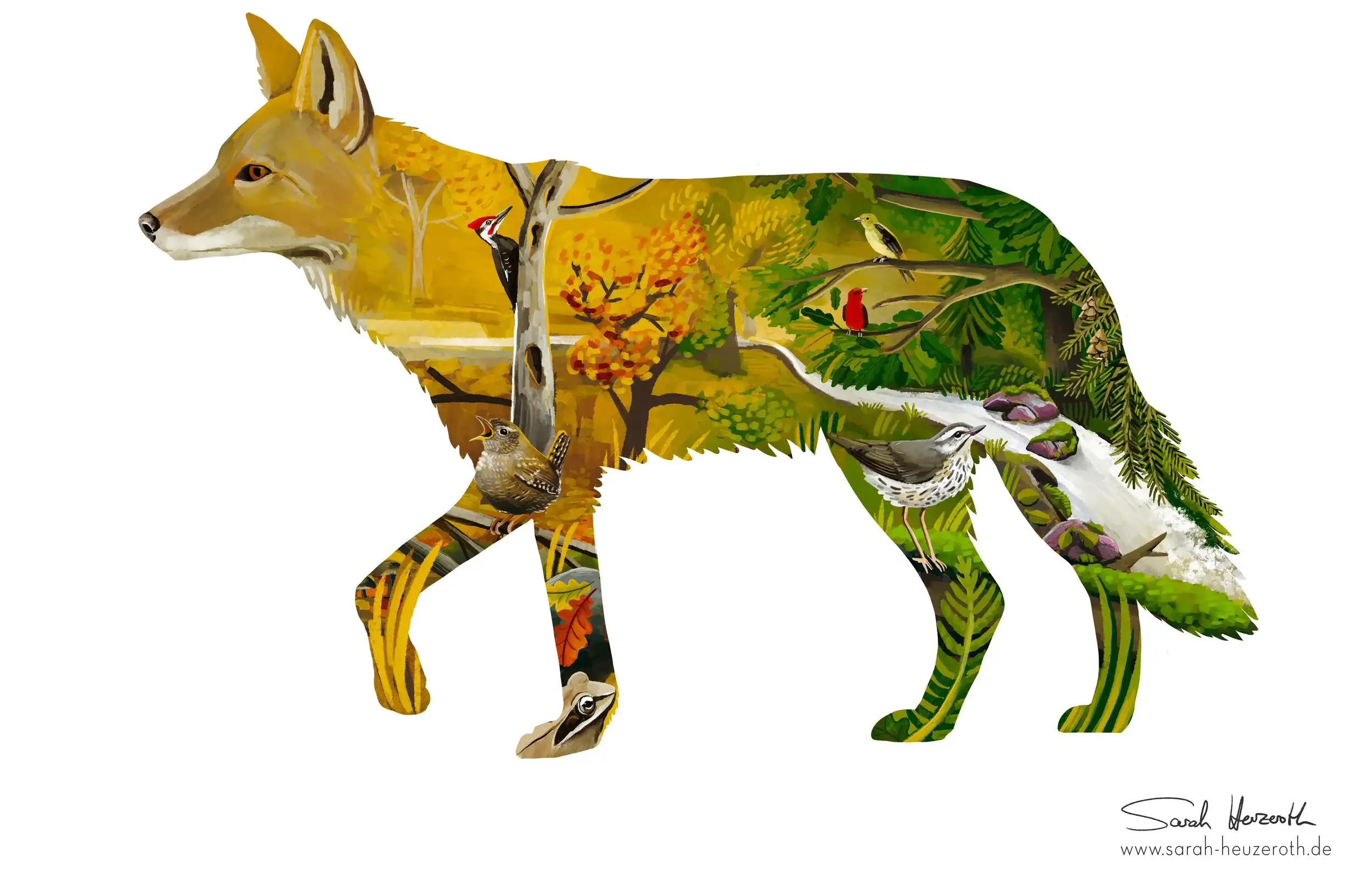
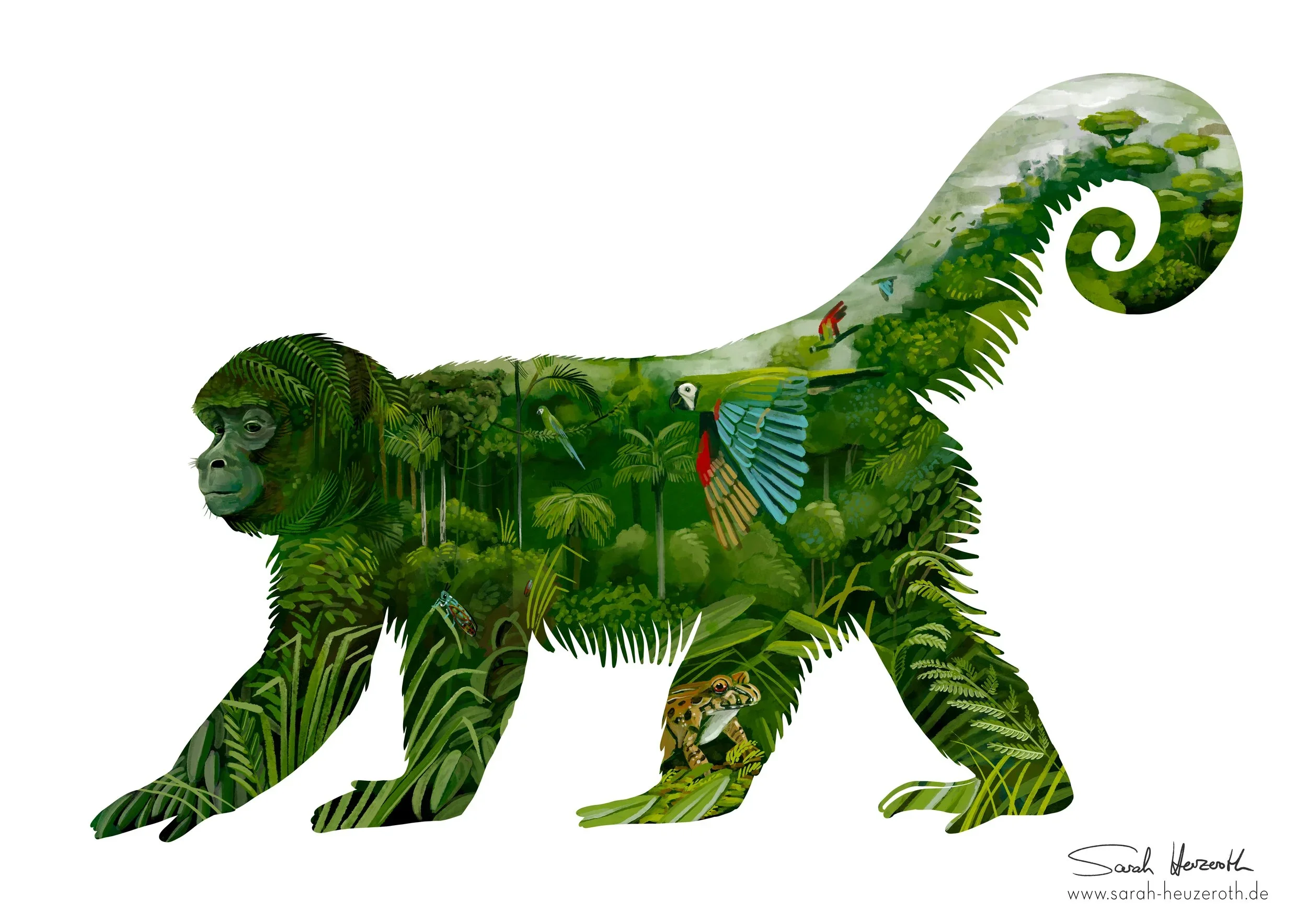
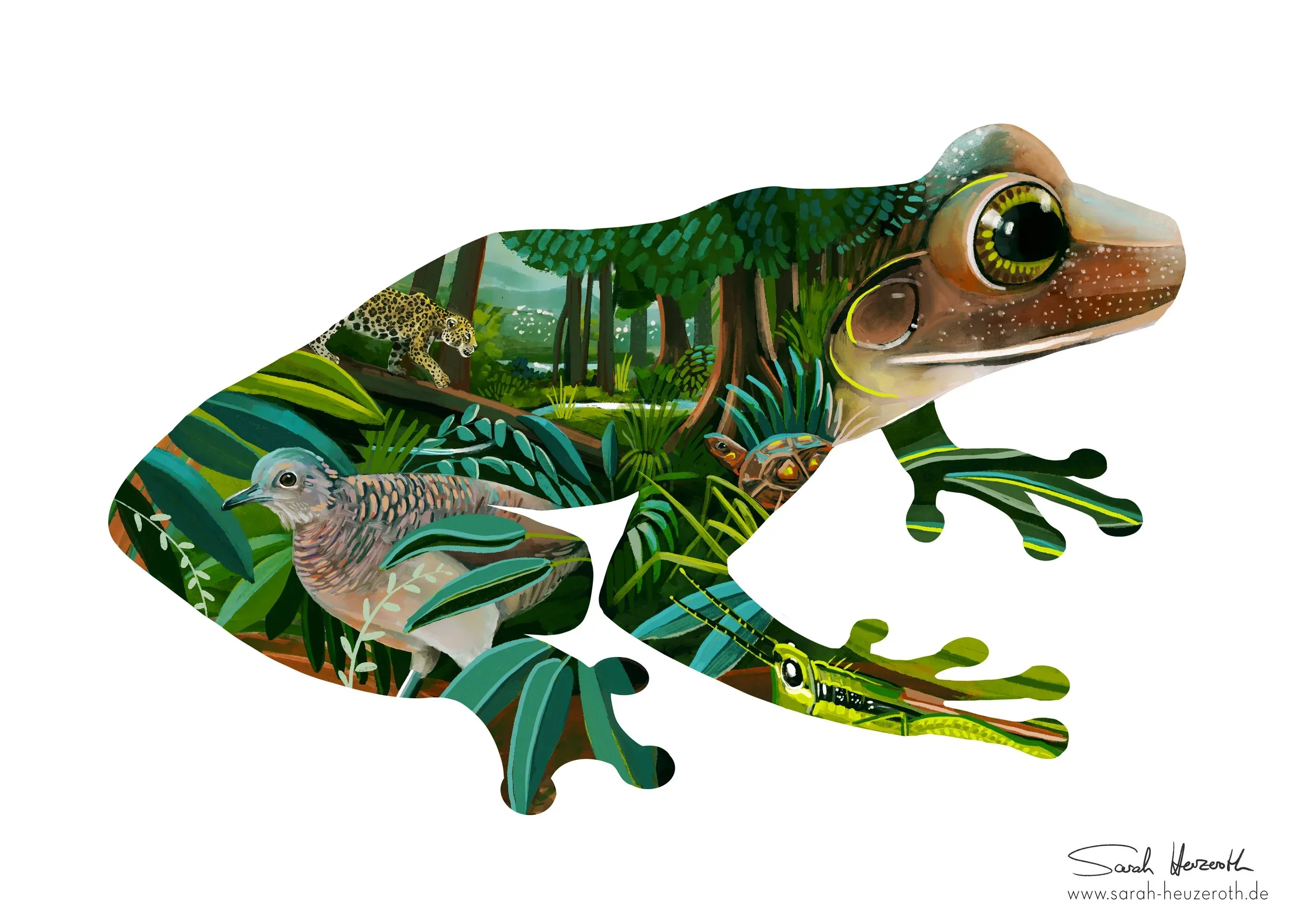
Community partners had another opportunity to be a leading voice, and that was in the visual representation of the project. Through a previous study in Ecuador, Buřivalová had connected with Sarah Heuzeroth, a Hamburg-based scientific illustrator. She asked Heuzeroth to illustrate each baseline site, following the local teams’ direction on which animal should be the silhouette and which others were important to include. “It expresses what the communities or local researchers see and hear their forest as,” Buřivalová says, “which I think is more interesting than if a scientist from the Czech Republic living in the U.S. and an illustrator living in Germany do their interpretation!”
These illustrations provide a visual representation of the rich soundscapes of forests in Wisconsin (coyote), Peru (wooly monkey), and Ecuador (frog). Hover with your mouse or tap on the illustrations to reveal more details.
Listening On
To get to work analyzing the terabytes and terabytes of data, a copy of the data has to get to the computers in Buřivalová’s lab. (Per their data agreement, the main copy remains in the partner country.) It doesn’t move through servers or the cloud to get to UW–Madison: “From the more remote areas, it travels essentially as a hard drive in someone’s luggage,” she says.
Once the physical copies are safely in the lab, the files get uploaded, processed, and run through a variety of algorithms — both existing models and bespoke ones, like one that detects gunshots to quantify hunting. Existing models like BirdNET identify most bird sounds to a species level. However, many — if not most sounds, such as the hundreds of species of insects and frogs, still aren’t identifiable even with the best AI. That’s because researchers still don’t know what many of these species sound like. “AI helps us see what we know,” Buřivalová says, “so we cannot train machines to recognize them.” The scientists summarize all the sounds of the forests, from birds to insects to mammals, to chart consistent peaks and valleys — a “shape” of daily activities. This led Buřivalová and her team to a key discovery: each intact forest has a unique sound signature.
“It has a profound consequence for conservation because it means that if it holds, if it’s true, we can then use the baselines for conservation projects to compare themselves to a local baseline.” For example, as a future reforestation project is under way, those soundscapes can be compared to the baseline to see if the conservation efforts are moving it closer to how the forest used to be; used to sound. “We can really measure impact on a case-by-case basis rather than on average.”
In May 2026, the project culminated in a landmark study showing the effectiveness of bioacoustics for biodiversity monitoring. The paper was published in Global Change Biology, including all of the local community partners as coauthors. Shortly after, Buřivalová launched an interactive platform that makes one month of sounds and images from each site publicly available.
She already has the process for deploying the technology, supporting on-the-ground teams and processing the data. Now, Buřivalová is looking to grow the Soundscape Baseline Project’s reach — get more recording tech into more forests. “My goal is to find funding so that we can cover all 181 ecoregions with intact forests left.”
With a dataset like that, it’d be difficult for any forest decisions to be made without considering biodiversity, and that’s exactly what Buřivalová hopes to see. “Right now, a lot of decisions have the excuse, ‘Oh, biodiversity is so hard to quantify. We don’t really know,’ ” she says. “With deforestation, you can measure it, so you kind of have to consider it … What I want to happen is that whenever someone is making a decision about some forest, it is inevitable that they have to consider biodiversity.”
The Soundscape Baseline Project holds another benefit, too, in its creation of a sort of forest time capsule. Think of the power of sound: a melody that takes you right back to a special moment. The yearning you feel to hear a lost loved one’s voice one more time. Buřivalová’s soundscapes offer us that, too. “I think it’s an important memory of the ecosystem,” she says. “Even Aldo Leopold made sound recordings during his time, and we see a value of this information even now.”

