


Shh … do you hear that? It’s the sound of the wind.
And if you can hear the wind, that means the UW–Madison WiscWind team can taste the victory of another annual U.S. Department of Energy Collegiate Wind Competition.
Each year, students in this club work together to:
- Design, build, and test a small-scale wind turbine
- Develop a detailed project development plan for a large-scale wind farm
- Conduct outreach to local communities and industry professionals
These three tasks guide the work of WiscWind’s subteam leads throughout the year, ultimately culminating in a nationwide competition against university teams from across the country. This May, WiscWind students will travel to California Polytechnic State University in hopes of bringing home another victory.
Watch now to learn how these students are blowing away the competition.
Transcript
Transcript may be edited for clarity or brevity.
*Fan*
The UW–Madison WiscWind club is a student team that competes in the U.S. Department of Energy’s annual Collegiate Wind Competition.
Mark Kuzel: My name is Mark Kuzel. I’m a senior studying mechanical engineering. I’m currently president and team lead for WiscWind. We are an engineering competition club. We participate in the collegiate wind competition run through the Department of Energy. My job as president is to coordinate with our different subteams and my subleads about what’s going on in the club, coordinating design, and making sure we can have a good turbine by the time competition rolls around. It’s been a lot of fun being a part of WiscWind these past four years. I’ve learned a lot of things that I wouldn’t have in the classroom.
Students split up into subteams to design, build, and test a small-scale wind turbine, develop a detailed project development plan for a large-scale wind farm, and conduct outreach to local communities and industry professionals.
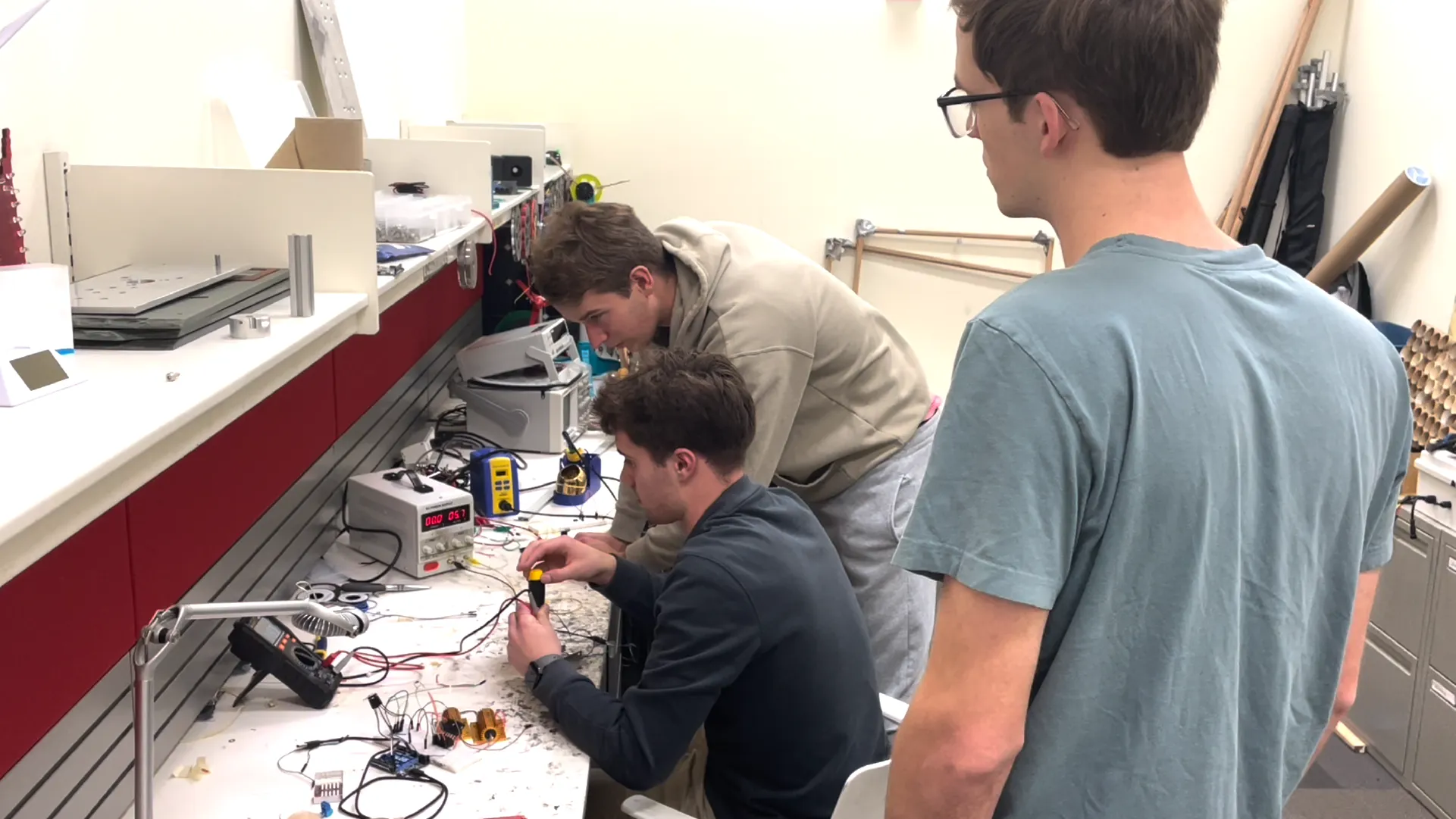
Andrew Hensal: My name is Andrew Hensal. I’m a sophomore studying electrical engineering here at UW. I’m the WiscWind electrical team, subteam, team lead. This semester, some new things that we’re trying out. Our turbine creates electricity, and that electricity has to be dealt with, and so we have to “fake” electricity usage, so we’re designing a new load system this semester that will hopefully make things and operations a lot more smooth, and our testing process, and we’re also working on just cleaning up and refining different systems like boards and other parts of the system that we already have. I decided to join WiscWind, because, well, like every freshman does, I went around to the club fair and I looked at all the different clubs. And this one kind of stuck with me. It was stuff I could understand and jump in and work on as a freshman.
This year’s competition challenges teams to develop a wind turbine project in the state of Oregon. The WiscWind team will travel to California Polytechnic University in May to compete against other universities.
Ben Hein: My name is Ben. I’m the project development team lead for WiscWind. I’m an environmental engineering major minoring in environmental studies as well as engineering for environmental sustainability. Every year, project development is tasked with siting and designing a wind farm. This year, the project is in Oregon, on-shore wind farm. So far last semester, we picked out our site and now this semester, we have to go through and optimize our site layout. We also have to do a full financial analysis to show that the site is profitable and that our proposed design is economically feasible. I decided to join WiscWind because I thought it was a good opportunity to kind of mix my two interests. Environmental engineering is a lot of big project planning as well so, kind of ties in with that, and I’m also pretty passionate about the environment. Renewable energy is just a part of the environment that I’m interested in. I think it’s pretty important, too, for our future to make sure we have a sustainable way to get energy. It’s just a really interesting club. Definitely in a lot of environmental studies classes you learn a lot about renewable energy and the importance of it, and I think this really gets me to grasp how large the industry is and how important it is to make sure we keep investing in it and really puts into perspective the things you learn in class.
WiscWind has made it to the final stage of the competition multiple years in a row — even winning the project development contest in 2024. They hope to continue that legacy this year.
Maggie Kraft: I’m Maggie. I’m a senior. I’m studying biochemistry, and I’ve been the connection creation lead for WiscWind for the past year and a half. Connection creation, we do a lot of outreach. It’s not as hands-on as the parts of the club, but we do outreach, we do community science nights at elementary schools. We run the Instagram. We help with KidWind in the spring. Kind of our goal is to get people in the community involved with clean energy and it’s a really fun way to get involved with the community on campus and in the local Madison area. Basically, KidWind is a statewide competition. A lot of schools, elementary, middle, and high schools from across the state come here to compete. They’ve already been competing in their local communities and they come here. It’s kind of a big deal. Other parts of KidWind, we have a couple guest speakers. A lot of different clubs come in. There’s a lot of tables that have different activities for kids to explore. My favorite part about WiscWind is going to elementary schools and stuff. Getting to have this silly little wind turbine activity that they get to play around with and seeing how excited kids and families get to be able to participate in that and talk to them and see them get excited about science, that’s definitely the best part for me.
*Fan*

